











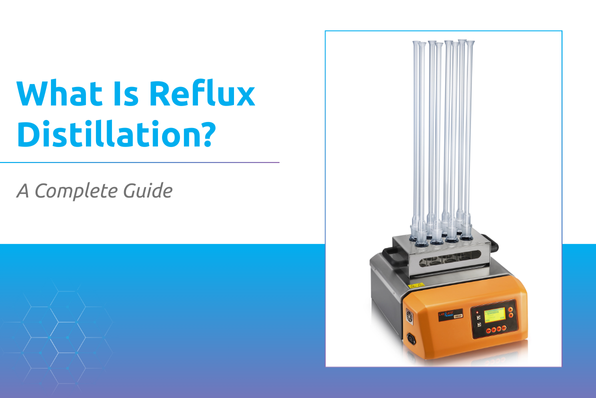
Reflux distillation is a core separation technique used across chemical synthesis, purification protocols, and extraction systems. The method allows volatile components of a mixture to be boiled, condensed, and returned to the reaction vessel repeatedly, assuring enhanced separation without significant loss of material. This looping mechanism refines the distillation process by enabling extended interaction between the vapour and liquid phases.
In industrial and research environments, particularly within pharmaceutical, petrochemical, and academic settings, reflux distillation enhances purity levels, controls reaction conditions, and maintains system thermal stability. Glassware quality and design precision, particularly when working at elevated temperatures, directly affect output and reliability.
Laboratory setups require robust, heat-stable borosilicate glassware that complies with ASTM E438 (Type I, Class A) and ISO 3585. A standard reflux distillation assembly includes:
| Component | Function |
| Round Bottom Flask | Ensures uniform heating and smooth boiling; available with interchangeable joints. |
| Liebig/Allihn Condenser | Facilitates effective vapour condensation through cooling surface contact. |
| Claisen Adapter | Offers dual neck access for thermometer insertion or additional reagent introduction. |
| Heating Mantle | Provides even heat distribution without direct flame contact. |
| Boiling Chips | Prevent bumping and maintain steady boiling conditions. |
Borosil Scientific’s round bottom flasks are manufactured from 3.3 low expansion borosilicate glass with uniform wall thickness distribution. These flasks are available in narrow mouth, short neck formats, often with integrated interchangeable joints to match system configurations.
The system begins with heating a liquid mixture in a round bottom flask. Vapours rise through the column and flow into a condenser. Instead of being collected immediately, condensed vapour flows back into the flask. This cyclic condensation maintains a closed-loop system, conserving the solvent and controlling temperature.
Reflux time is very important. A prolonged reflux allows components to interact under steady thermal conditions. The backflow of condensed liquid makes sure that any unreacted materials remain in the system long enough to achieve equilibrium or complete reaction.
Knowing what to choose when it comes to reflux and simple distillation is a matter of understanding what each process does. Here’s how you can make your choice:
| Criteria | Reflux Distillation | Simple Distillation |
| Application | Complex mixtures, extended reactions | Separation of solvents or liquids with large boiling point differences |
| Temperature Stability | Maintains steady temperature over time | The temperature rises steadily throughout |
| Solvent Recovery | Recycled during the reaction | Collected at the end |
| System Complexity | Requires condensers and adaptors | Relatively simple apparatus |
In settings requiring consistent reflux ratios and extended reaction durations, such as synthesis of esters, amides, or polymer precursors, the reflux approach yields better conversion and purity.
Round bottom flasks are the industry standard in reflux systems due to:
By contrast, flat bottom flasks are more suitable for simple storage or where mechanical stability is essential, though they are less optimal for heat transfer.
Multi Neck flasks, available in 2, 3, or 4-neck variants, facilitate complex reflux reactions by accommodating:
Borosil Scientific’s multi-neck flasks comply with USP Type I standards and are fabricated for use under inert atmospheres and controlled pressure settings. The standard joint configuration provides seamless integration with condensers, dropping funnels, and vacuum traps.
Temperature uniformity and control are non-negotiable. Heating mantles used in conjunction with reflux setups must:
When heating is combined with magnetic stirring, make sure that the stir bar size and flask base are compatible for efficient mixing. Direct flame heating is generally avoided due to uneven thermal gradients.
Reflux distillation finds critical relevance across multiple scientific and industrial applications due to its ability to maintain consistent thermal and solvent conditions. Use cases include:
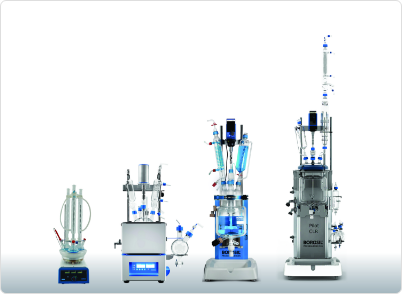
Borosil Scientific’s round bottom flasks, when paired with jointed condensers, heating mantles, and adaptors, allow for modular, leak-proof reflux setups suitable for scale-up and method reproducibility across lab types.
Regular inspection of glassware, joint lubricants, and seals is essential. Here are practical guidelines:
Proper cleaning and drying after each use reduces the risk of contamination or ghosting between runs.
A complete reflux distillation setup should include:
| Component | Features |
| Round Bottom Flask | 3.3 Low Expansion, Short Neck, I/C Joint, USP Type I |
| Multi Neck Flask | Multi-port with interchangeable joints, acid-resistant |
| Condenser | Allihn or Liebig models with standard joint sizes |
| Dropping Funnel | Graduated, with glass stopcocks and ground joint connections |
| Support Stands & Clamps | Corrosion-resistant metal with PTFE lined grips |
All critical glass parts are ISO 3585 compliant and manufactured in Class 8 cleanroom facilities to reduce contamination.
Precision reflux distillation requires more than technique. It demands purpose-built, dimensionally consistent borosilicate components capable of withstanding thermal cycles and chemical attack.
At Borosil Scientific, we provide analytical-grade round bottom and multi neck flasks, condensers, and associated jointware for building high-integrity reflux systems. Whether you’re optimising a reaction or scaling a protocol, our products offer dependable repeatability and extended service life.