




• image not found
  • image not found
  • image not found
  • Products Certificates
  • E-catalogue
    • Download
  • Resources
    • Blog
    • Brochures and flyers
  • Career
  • Distributors
  • Global Presence
  • Contact Us
logo
  • About us
  • Products
  • Services
  • Industries
  • Investor
  • News & Events
image not found
Laboratory Glassware & Consumables
image not found
Laboratory Instrumentation
image not found
Pharma Primary Packaging
image not found
Laboratory Process Systems
image not found
Industrial Process Equipment
image not found
OEM
Laboratory Glassware Filtration Products Analytical Vials
  • Volumetric Glassware
  • Laboratory Bottles and caps
  • General Laboratory Glassware
  • Glassware For Microbiology
  • Quartz & Sintered Ware
  • Filter Membranes
  • Glass Filtration Assembly
  • Stainless Steel Filtration Assembly
  • Filter Papers
  • 2ml HPLC VIALS/CLOSURES/KIT
  • 20ml HEADSPACE GC VIALS/CLOSURES/KIT
  • Certified Pre-assembled EPA/TOC VIALS/KIT
  • Accessories
  • metal accessories
image not found
Laboratory Glassware & Consumables
Volumetric Glassware, Reagent Bottles, Beakers, Test Tubes, Petri Dishes
1500 W (10% OFF)
Nutrition Environment Lab Essentials Life sciences Liquid Handing Lab Water
  • Nitrogen and Protein Analysis
  • Fat Analysis
  • Fiber Analysis
  • Moisture Analysis
  • Water Testing
  • UV Visible Spectrophotometers
  • Electrochemistry
  • Heating & Cooling Circulators
  • Heating Mantles
  • Vacuum Pumps
  • Glass Dryer
  • Water Distillation
  • Water Baths & Oil Baths
  • Laboratory Stirrers
  • Centrifuges
  • Vortex Mixers
  • Dry Baths
  • Bottle Top Dispensers
  • Digital Burettes
  • Micropipettes
image not found
Laboratory Instrumentation
Kjeldahl Digesters, Kjeldahl Distillation Units, Fat Analyser, Water Bath, Stirrer, Centrifuge
1500 W (10% OFF)
image not found
Pharma Primary Packaging
Tubular Glass Vials, Glass Ampoules
1500 W (10% OFF)
Mini Reactor System Jacketed Reactor System Parallel Reaction System Automated Reaction System Photo & Speciality System Utilities & Accessories
image not found
Laboratory Process Systems
We Automate Chemistry
Leading Manufacturer of Industrial Process Equipment
logo
    logo
  • Home
  • Products
    • Glassware & Consumables
      • LABORATORY GLASSWARE
          • Volumetric Glassware
          • Laboratory Bottles and caps
          • General Laboratory Glassware
          • Glassware For Microbiology
          • Quartz & Sintered Ware
      • FILTRATION PRODUCTS
          • Filter Membranes
          • Glass Filtration Assembly
          • Stainless Steel Filtration Assembly
          • Filter Papers
      • ANALYTICAL VIALS
          • 2ml HPLC VIALS/CLOSURES/KIT
          • 20ml HEADSPACE GC VIALS/CLOSURES/KIT
          • Certified Pre-assembled EPA/TOC VIALS/KIT
          • Accessories
    • Laboratory Instrumentation
      • Nutrition
          • Nitrogen and Protein Analysis
          • Fat Analysis
          • Fiber Analysis
          • Moisture Analysis
      • Environment
          • Water Testing
          • UV Visible Spectrophotometers
          • Electrochemistry
      • Lab essentials
          • Heating & Cooling Circulators
          • Heating Mantles
          • Vacuum Pumps
          • Glass Dryer
          • Water Distillation
          • Water Baths & Oil Baths
          • Laboratory Stirrers
      • Life sciences
          • Centrifuges
          • Vortex Mixers
          • Dry Baths
      • Liquid Handing
          • Bottle Top Dispensers
          • Digital Burettes
          • Micropipettes
      • Lab Water
    • Pharma Primary Packaging
    • Laboratory Process Systems
      • Mini Reactor System
      • Jacketed Bench System
      • Parallel Reaction System
      • Automated Reaction System
      • Photo & Speciality System
      • Utilities & Accessories
    • Industrial Process Equipment
    • OEM
    • About us
    • Products
    • Services
    • Industries
    • Investor
    • News & Events
    • Products Certificates
    • E-catalogue
      • Download
    • Resources
      • Blog
      • Brochures and flyers
    • Career
    • Distributors
    • Global Presence
    • Contact Us

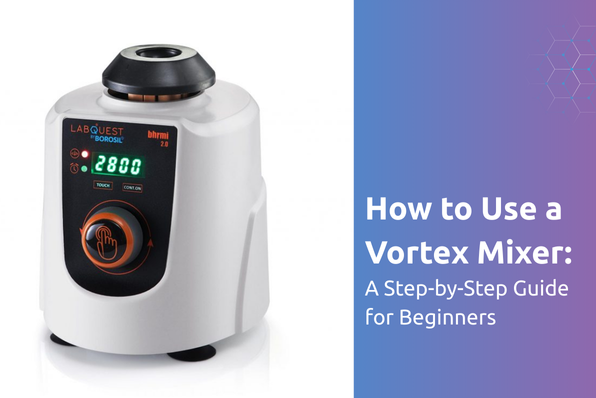
How to Use a Vortex Mixer: A Step-by-Step Guide for Beginners

How to Use a Vortex Mixer: A Step-by-Step Guide for Beginners

The vortex mixer is a staple of laboratory workspaces. Whether used for suspensions, reagent blending, or gentle emulsions, its reliability makes it indispensable in pharmaceutical, chemical, and analytical testing environments. However, to extract consistent performance, it is essential to understand proper operating technique, accessory selection, and maintenance.

This post outlines standard operating procedures and practical advice tailored for vortex mixer uses, with a particular focus on the equipment offerings.

Understanding Core Functions: Vortex Mixing in Laboratory Workflows

The vortex mixer uses an eccentric drive to generate orbital motion at the base, translating to a swirling effect in liquid samples. This mechanism supports a range of use cases:

Common ApplicationPurpose
Resuspending centrifuged pelletsHomogenisation of cells or particulates
Preparing reaction mixesEnsures uniformity before analysis
Blending reagents in analytical vialsPrevents settling prior to injection
Emulsifying immiscible liquidsRapid pre-mixing for further processing

At Borosil Scientific, we offer units like the BHRMI vortex mixer that come with variable speed settings, multi-tube adaptors, and sturdy rubber platforms, making them suitable for diverse workflows.

Components and Configuration: Equipment Familiarity

To operate a vortex mixer efficiently, users must first understand its structural layout and control options. Familiarity with these components reduces the risk of misuse and ensures proper mixing without damage to labware. Below is a breakdown of the main features found in most bench-top vortex mixers.

Before the operation, users must understand the core components:

  • Mixing Pad/Platform: Rubberised pad for direct tube contact
  • Speed Control Dial: Adjustable rpm, often 300 to 3200 rpm
  • Mode Switch: Toggle between touch and continuous mode
  • Multi-tube Head (optional): For high-throughput environments
  • Non-slip Base: Suction feet ensure instrument stability

Operating Procedure: Step-by-Step Guide

Safe and consistent use begins with following a logical setup and operation sequence. Below are the vortex mixer principles used in research, pharma, and analytical labs. Each step ensures equipment safety, user comfort, and reproducible mixing.

Placement

  • Always position the mixer on a flat, stable, and non-slip surface. A lab bench or anti-vibration table is ideal.
  • Keep it away from equipment that generates vibration or electromagnetic interference, such as centrifuges or analytical balances.
  • Ensure adequate clearance around the device to allow safe handling of tubes.

Power Connection

  • Before plugging in, confirm that the vortex mixer’s voltage rating (usually 220–240 V for Indian labs) matches your wall socket output.
  • Use a grounded socket with surge protection. Power fluctuations can affect motor performance or damage internal electronics.

Mode Selection

  • Most mixers come with two operating modes:
    • Touch mode: Active only when pressure is applied to the mixing pad. Ideal for short, manual mixing.
    • Continuous mode: The mixer stays on without manual input. Recommended for batch mixing or when using a multitube adaptor.
  • Always start in touch mode during setup or training before progressing to continuous operation.

Speed Adjustment

  • Begin with the lowest speed setting, especially if mixing biological materials, foaming reagents, or viscous samples.
  • Gradually increase the rpm to the desired level. Most general-purpose mixers allow adjustment from 300 to 3200 rpm.
  • Observe the sample’s behaviour, splashes or vortex instability indicate the speed is too high.

Sample Handling

  • Tubes should always be sealed with secure caps or parafilm to prevent spillage or aerosol release.
  • Gently press the sample tube vertically onto the centre of the mixing pad. Avoid angled application, which causes uneven vortex formation.
  • Do not overload the platform. Use one tube at a time unless using a multi-tube accessory.

Duration

  • For standard liquids or buffers, a mixing time of 5-10 seconds is typically sufficient.
  • Emulsions, particulate suspensions, or layered solvents may need 15-30 seconds to homogenise properly.
  • Never exceed the recommended mixing duration unless validated by an SOP.

Shutdown and Cleaning

  • Once mixing is complete, reduce rpm to zero using the dial.
  • Switch off the device and unplug it before any cleaning procedure.
  • Wipe down the platform and housing with a lint-free cloth moistened with 70% isopropyl alcohol.
  • Avoid corrosive cleaning agents like acetone or benzene that degrade rubber pads and plastic housings.
  • Let all surfaces dry completely before reconnecting power.

Following these steps ensures consistent operation and extends the service life of your mixer while reducing cross-contamination risk during critical workflows.

Application-Specific Configurations

The efficiency of vortex mixing also depends on using the correct accessories for different tube formats. This table offers configuration recommendations based on tube type.

Sample TypeRecommended Accessory
1.5 mL microtubesMultitube head with foam insert
15 mL conical tubesStandard mixing pad
PCR strip tubesStrip-compatible tube adaptor
50 mL centrifuge tubesWide rubber pad or specialised holder

At Borosil Scientific, we offer compatibility with all standard lab tubes. Adaptor heads are chemically resistant and designed to distribute mechanical load evenly.

Best Practices and Precautions

To keep your mixer running safely and efficiently, follow these usage recommendations:

  • Do not overload multitube attachments; balance is critical.
  • Avoid applying lateral force to glassware.
  • Use appropriate PPE (lab coat, gloves, eye protection).
  • Do not mix flammable solvents near open heat sources.

Maintenance and Calibration

While vortex mixers require minimal upkeep, proactive care extends longevity. Use the table below for scheduling basic maintenance tasks.

TaskFrequencyNote
Inspect power cableMonthlyLook for insulation wear or plug damage
Clean platform and baseWeeklyUse IPA; ensure dry surface before use
Lubricate motorAs per manualOnly in non-sealed motor units
RPM verificationAnnuallyTachometer-based check for regulated labs

Use Case Integration in Analytical Labs

In pharmaceutical QC and method development labs, vortex mixers are often located at the front end of sample prep lines. Here are common scenarios:

  • Preparing reference solutions for HPLC/GC
  • Mixing internal standards into sample matrices
  • Reconstitution of lyophilised drugs prior to vial filling
  • Sample agitation in dissolution testing workflows

These mixers are often installed near analytical weighing stations or sample prep areas, allowing quick transitions between weighing, mixing, and injection.

Conclusion: 

Correct vortex mixing supports reproducibility, especially when preparing reagents or standards for trace-level analysis. The vortex mixer principle lies in creating a rapid circular motion that generates a vortex in the liquid, promoting fast and uniform mixing without the need for magnetic stir bars or shaking.

From touch-speed control to multi-tube capacity, Borosil Scientific’s vortex mixers are engineered for bench stability, sample compatibility, and continuous operation.

To select the right model or discuss integration with your lab’s test tube or vial formats, reach out to Borosil Scientific’s technical team or refer to the latest e-Catalogue.

We’re here to support your precision workflows, one reliable mix at a time.

Be the First
Sign Up Now with Your Email for Exclusive Updates & Stay Ahead with Borosil Scientific!

    logo
    Enabling the Future of Science
    Company
    • About us
    • News & Events
    • Career
    • Corporate Video
    Products
    • Laboratory Glassware & Consumables
    • Laboratory Instrumentation
    • Pharma Primary Packaging
    • Process equipment
    Support
    • E catalogue
    • Resources
    • Product Certificates
    • Blogs
    • Contact Us
    Get In Touch
    • image not found
      +91 22 6740 6300
    • image not found
      bsl@borosil.com
    • image not found
    • image not found
    • image not found
    • image not found
    Copyright © 2025 borosilscientific.com. All rights reserved.
    • Terms & Conditions
    • Privacy Policy
    • Sitemap
    Designed & Developed by iDigitalise
    Inquiry