












Glass Filtration Assembly

-
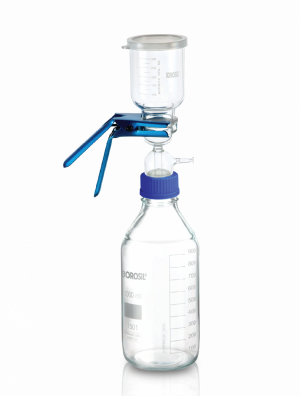
-
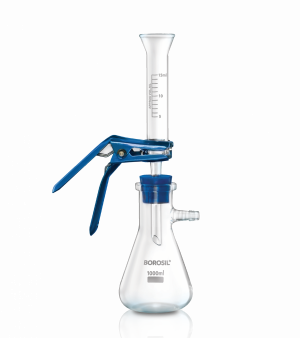
Glass Micro-Filtration Assembly
With glass funnel, receiver flask, filter support base, silicone stopper and aluminum clampView Details -
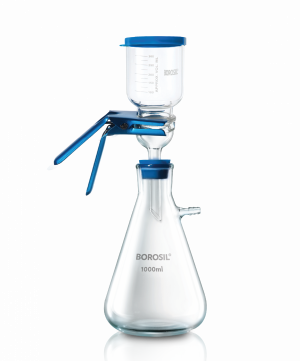
Glass Filtration Assembly
With glass funnel, receiver flask, filter support base, silicone stopper and aluminum clampView Details -
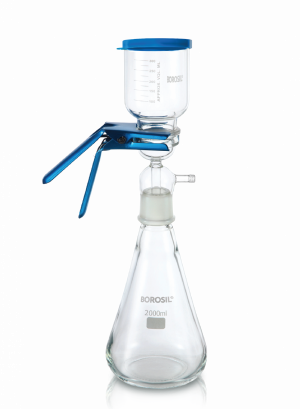
Glass Filtration Assembly, With Conical Flask
With glass funnel, receiver flask, filter support base and aluminum clampView Details
Types of Glass Filtration Assemblies
Multiple configurations are available depending on sample type, filtration volume, and compatibility with support hardware. At Borosil Scientific, each assembly is manufactured using 3.3 borosilicate glass and features a chemically inert PTFE filter support base for high corrosion resistance. Products include:
| Model Name | Filter Diameter | Flask Type | Unique Features |
| Glass Filtration Assembly with Adapter | 47 mm | GL45 bottle | Universal GL45 adapter for broad compatibility |
| Glass Micro-Filtration Assembly | 47 mm | Receiver flask | Includes silicone stopper and aluminium clamp |
| Glass Filtration Assembly | 47 mm | Receiver flask | Basic configuration, suitable for general use |
| Glass Filtration Assembly with Conical Flask | 47 mm | Conical flask | Prevents splashing, good for aggressive solvents |
All units include:
- Glass funnel (300 mL)
- PTFE filter support base or sintered glass disc
- Aluminium spring clamp
- Stopper or adapter based on the assembly
Assemblies are designed for 47 mm membranes (sold separately) and are suited for fine particulate filtration and microbial testing.
Advantages of Glass Filtration Assemblies
Assemblies from Borosil Scientific meet ISO quality parameters and are compatible with GMP and GLP workflows. Their key benefits include:
- Material Integrity: The 3.3 borosilicate glass shows low thermal expansion, resists most acids and organic solvents, and is free from leachables.
- Operational Safety: PTFE filter bases offer non-reactivity with corrosive filtrates. GL45 adapters allow leak-proof connections to vacuum systems.
- Reusable Efficiency: Made to be sterilised again and again. Can be autoclavable at 121 °C and 15 psi.
| Feature | Benefit |
| Borosilicate Glass 3.3 | Chemical resistance, long lifecycle |
| PTFE Base | Suitable for strong acids, oxidisers |
| GL45 Adapter Assemblies | Wide mouth, screw-thread compatibility for quick connections |
| Silicone Stopper Assemblies | Flexible fit, resistant to high vacuum |
In assemblies such as the Glass Filtration Assembly with conical flask, the narrower profile improves liquid flow dynamics and reduces aerosol formation. The conical shape is especially suitable in solvent recovery setups.
Applications of Glass Filtration Assemblies
Glass filtration assemblies are important tools in many different lab activities. They are good at holding onto particles and transferring germ-free fluids. Here are some applications of glass filtration assemblies:
- Membrane Filtration for Microbial Analysis:
- Water quality testing for total coliform counts
- Bioburden testing in pharmaceutical QC
- Media sterilisation by micro-filtration
- Particulate Analysis in Solvents:
- Pre-filtration of HPLC samples
- Removal of precipitates from chemical mixtures
- Vacuum Filtration for Sample Concentration:
- Evaporation studies
- Solvent extraction methods
Assemblies like the Glass Micro-Filtration Assembly are preferred in QC labs for sterile filtration of culture media, thanks to their robust sealing and glass compatibility with thermal sanitation protocols.
Below is a simplified compatibility matrix:
| Sample Type | Suggested Assembly | Comments |
| Culture Media | Micro-Filtration Assembly | Supports sterile filtration, reusable base |
| Organic Solvents | Assembly with Conical Flask | Better pressure control and minimal splash risk |
| Environmental Water | Filtration Assembly with Adapter (GL45) | Easy connection to suction line setups |
| Particulate Removal | Basic Glass Filtration Assembly | General purpose with durable sintered base |
All assemblies can be autoclaved at 121 °C for 30 minutes. For aggressive cleaning protocols, disassemble and soak in neutral detergent prior to sterilisation.
They offer higher chemical compatibility, reusability, and dimensional accuracy compared to plastic setups. Assemblies from Borosil Scientific are designed to minimise leakage during vacuum operations and to deliver consistent membrane support during filtration.
Commonly used in pharmaceutical manufacturing, water testing labs, chemical synthesis setups, and research institutions. In India, they are a mainstay in both public and private sector QC labs.
A vacuum source pulls liquid through a membrane filter that is on a base made of glass or PTFE. The particulates stay on the membrane, and the filtrate builds up in the flask below. Models like the GL45 assembly make it easy to install screw threads on bottles that are meant to receive them.
Key components of a glass filtration assembly include the glass funnel, PTFE or sintered base, silicone or GL45 sealing adapter, receiver flask, and aluminium clamp. All parts in Borosil Scientific assemblies are precision-manufactured and designed to be compatible with standard 47 mm membranes.
They reduce plastic waste significantly. Because they last so long, you won’t need to buy as many disposable items. Borosilicate glass doesn’t release microplastics or other chemicals when it’s heated or stressed. For labs that want to be more sustainable, switching to glass makes it cheaper and easier to follow environmental regulations.