













Vacuum Desiccators

How Vacuum Desiccators Work
Vacuum desiccators operate by reducing the internal pressure of a sealed chamber, accelerating moisture removal from samples. The vacuum pump draws out air, including water vapour, lowering relative humidity inside. This vacuum-induced environment significantly enhances the drying efficiency compared to atmospheric desiccators.
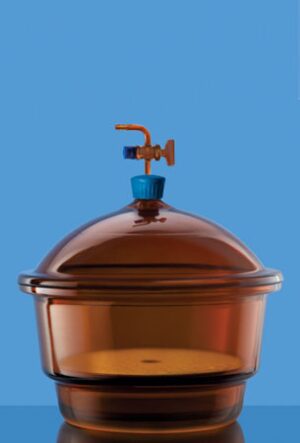
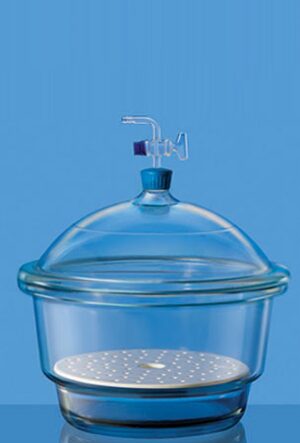
To maintain low humidity, a desiccant (typically silica gel) is placed at the bottom of the chamber. However, in vacuum models, it’s the pressure differential that drives performance, not just the desiccant. For instance, Borosil Scientific’s vacuum desiccator sets, such as the 3083 and 3085, feature glass stopcocks that provide secure vacuum retention and controlled pressure release.
Key Features of Vacuum Desiccators
The performance of any vacuum desiccator is directly tied to its material integrity, seal design, and user control. Below are critical features integrated into Borosil Scientific’s standard and amber vacuum desiccator sets:
| Feature | Borosil Scientific Specification |
| Stopcock Assembly | Fitted with a glass spindle for chemical resistance and vacuum stability |
| Flange Finish | Precision-ground glass flanges for airtight sealing |
| Plate Support | Internal ledge in the base accommodates porcelain support plate |
| Glass Material | Borosilicate, with clear and amber options |
| Design Suitability | Compatible with vacuum operations and routine drying under atmospheric pressure |
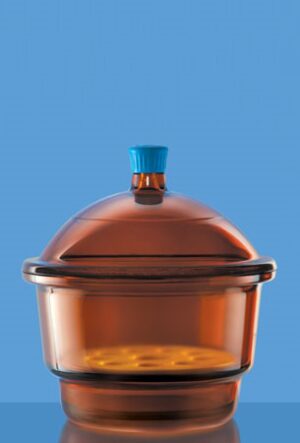
Additionally, models 3084 and 3085 offer amber glass, suitable for light-sensitive substances.
Applications of Vacuum Desiccators in Laboratories
The scope of vacuum desiccator usage spans across chemical, pharmaceutical, biotech, and analytical labs. Applications include:
- Moisture-sensitive sample storage: Especially important for hygroscopic chemicals like sodium hydroxide, lithium chloride or analytical reagents.
- Vacuum drying of solids: It is suitable for slowly drying powders and crystalline compounds, especially when heat-based drying methods may damage the sample structure.
- Storage post-drying: For weighing processes requiring a stable sample mass post-oven drying.
In places where the samples are constantly changing, vacuum desiccators help keep things moving quickly and cut down on downtime by getting rid of the need to re-dry.
Types of Vacuum Desiccators
Borosil Scientific offers a focused selection of desiccators designed specifically for vacuum applications. All models incorporate ground-glass precision and glass stopcocks for effective vacuum sealing.
| Product Code | Glass Type | Stopcock | Amber Option | Porcelain Plate | Vacuum Ready |
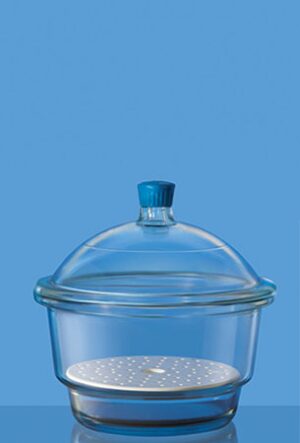
| 3082 | Clear | No | No | Yes | Yes |
| 3083 | Clear | Yes (glass) | No | Yes | Yes |
| 3084 | Amber | No | Yes | Yes | Yes |
| 3085 | Amber | Yes (glass) | Yes | Yes | Yes |
- Standard Clear Vacuum Desiccators: Suitable for general-purpose drying and short-term storage.
- Amber-Coated Vacuum Desiccators: These are best for light-sensitive compounds, protecting samples from photodegradation during storage or drying.
The inclusion of a porcelain plate across all models supports uniform drying and safe sample placement.
Materials Used in Vacuum Desiccator Construction
Borosil Scientific uses borosilicate glass because it is better at withstanding both chemicals and temperature changes than other types of glass. Structural durability makes sure that you can safely use the device under vacuum conditions. Key materials used are:
- Body and Lid: Borosilicate glass (Amber-coated variants for 3084 and 3085).
- Stopcock: Glass spindle (models 3083 and 3085), known for low permeability and high chemical resistance.
- Support Plate: Glazed porcelain, chemically inert and stable under thermal variation.
- Knob: High-grade plastic for ease of handling under vacuum conditions.
No metallic components are used in contact with samples, thereby reducing the risk of contamination.
Selecting the Right Vacuum Desiccator for Your Needs
Selecting the correct vacuum desiccator depends on the use case. The table below outlines practical selection criteria:
| Requirement | Recommended Model(s) |
| Vacuum drying only | 3082, 3083 |
| Light-sensitive sample storage | 3084, 3085 |
| Precision vacuum control | 3083, 3085 (Glass stopcock) |
| Limited budget | 3082 (no stopcock) |
For labs that are dealing with multiple requirements, keeping both amber and clear desiccators on hand allows flexibility across workflows.
Maintenance and Care Tips for Vacuum Desiccators
To maintain performance and prolong lifespan, the following practices are recommended:
- Inspect seals and flanges: You need to clean ground-glass surfaces regularly to make sure you get tight vacuum seals.
- Lubricate stopcock spindles: Use only vacuum-compatible grease if required.
- Avoid sudden pressure changes: Release the vacuum slowly to reduce the risk of implosion.
- Regenerate desiccants: Heat silica gel or equivalent desiccants as per usage cycles to restore absorption capacity.
- Use a rubber mat: Placing the desiccator on an anti-slip base reduces the risk of impact when you’re handling it.
Safety Precautions When Using Vacuum Desiccators
Working under a vacuum introduces risks. Proper operation and handling mitigate these effectively.
- Avoid using damaged glassware: Even minor cracks compromise the structure under vacuum.
- Apply vacuum gradually: Sudden drawdown can cause stress fractures.
- Wear safety goggles and gloves: Particularly when opening under pressure or handling hazardous samples.
- Avoid exposure to direct heat: Desiccators are not built for thermal applications unless specified.
- Monitor vacuum level: Excessive vacuum can degrade seals or cause implosion during structural failure.
All Borosil Scientific desiccators are designed for standard laboratory vacuums (~670 mm Hg) when used as per recommended practice.
Desiccators are used to maintain a dry environment, which is critical for the storage of moisture-sensitive reagents or for post-drying storage before gravimetric analysis.
Desiccators include standard (non-vacuum) and vacuum-compatible variants. Vacuum types like Borosil Scientific’s 3082–3085 sets offer superior performance, especially in drying workflows.
Silica gel, calcium chloride, and activated alumina are common desiccants. For high vacuum, silica gel is preferred for visual monitoring.
To protect samples from moisture reabsorption, to stabilise mass for weighing, and to safely store hygroscopic materials.
Apart from material differences (plastic vs glass), functional types include vacuum desiccators, light-protected (amber) models, and those designed for high-volume storage or analytical precision.