












Laboratory Dishes

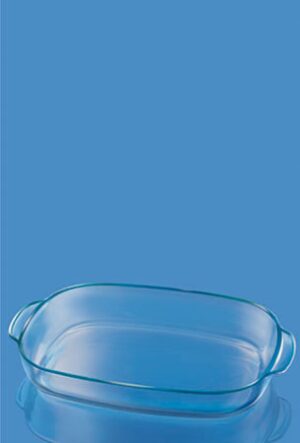
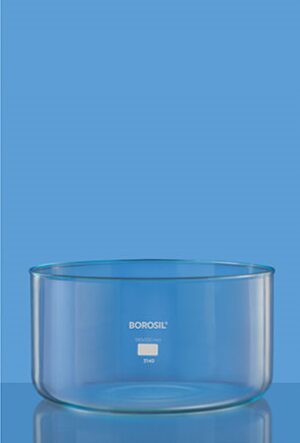
Crystallising Dishes Explained
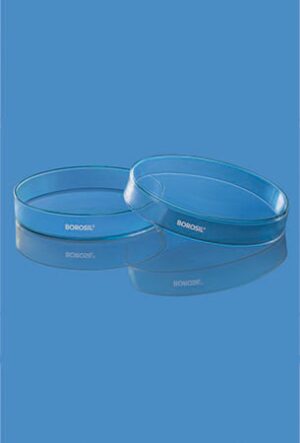
Crystallising dishes are one of the most common types of lab dishes and are very important for processes that involve slowly evaporating and forming crystals. Their shallow depth and wide mouth make them perfect for slowly losing solvents, which leads to controlled crystallisation. These are essential in pharmaceutical synthesis, analytical research, and chemical processing, where crystal purity and consistency of formation are required.
The 3140 Crystallising Dishes from Borosil Scientific are manufactured using high-quality borosilicate glass, known for its low thermal expansion and high chemical resistance. They are designed with reinforced rims for strength and safe handling during heating or autoclaving. Available in multiple capacities, they support repeated use under rigorous lab conditions. The flat base ensures stability on hotplates, and the transparent surface provides complete visibility of the contents during evaporation.
Types of Laboratory Dishes
Borosil Scientific offers a range of dish variants for various laboratory applications. These are designed for chemical resistance, thermal durability, and ease of operation. A comparison of major types is outlined below.
| Dish Type | Model Number | Description | Use Case |
| Crystallizing Dish | 3140 | Shallow, wide mouth | Solvent evaporation, crystallisation |
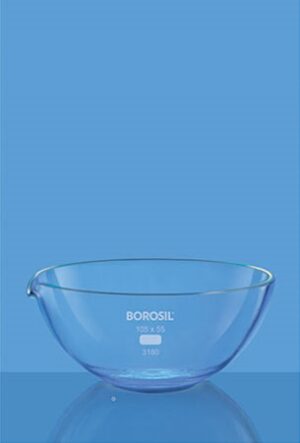
| Evaporating Dish | 3180 | Flat bottom, includes spout | Sample concentration, high-temp drying |
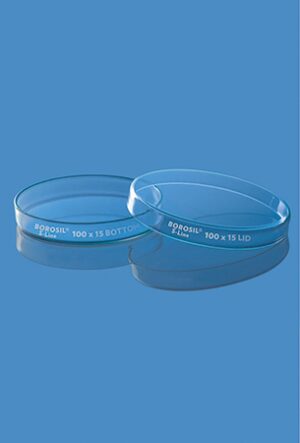
| Petri Dish – S-Line | 3165 | Consistent flatness, autoclavable | Microbial culturing, biological testing |
| Standard Petri Dish | 3160 | Standard dimensions, clear glass | Agar plating, sterile culture applications |
| Drying Tray | 3170 | Large surface area, low profile | Desiccation, storage, and general lab drying |
Materials Used in Laboratory Dishes
All lab glassware dishes produced by Borosil Scientific are made using borosilicate glass. This material is selected for its ability to withstand rapid temperature changes and resist chemical corrosion. It ensures dimensional stability over time, even under repeated sterilisation and high-heat exposure.
Comparison of Borosilicate vs. Other Materials:
| Property | Borosilicate Glass | Soda Lime Glass | Plastic (Polystyrene, PP) |
| Thermal resistance | High | Low | Varies (not for open flame) |
| Chemical resistance | Excellent | Moderate | Limited |
| Autoclavability | Yes | No | Usually No |
| Reusability | Long-term | Not recommended | Often single-use |
Applications of Laboratory Dishes
Each dish design supports specific laboratory workflows. These include:
- Crystallising dishes: Used in pharmaceutical compound development for crystal screening or slow evaporation.
- Evaporating dishes: Suitable for drying samples or reducing volumes in residue testing, gravimetric analysis, or acid digestion.
- Petri dishes: Standard in microbiology labs for growing bacterial or fungal colonies, as well as in sterile media transfer procedures.
- Drying trays: Used for oven drying of solids, temporary storage of glassware, or desiccant staging.
Selecting the Right Laboratory Dish with Borosil Scientific
Dish selection should begin with an understanding of the process involved. Whether evaporating volatile solvents or culturing live samples, parameters such as material, capacity, sterilisability, and thermal range must be matched.
Key decision factors:
| Requirement | Borosil Scientific Feature |
| Thermal stability | Borosilicate glass withstands direct flame |
| Chemical compatibility | Inert to acids, alkalis, and solvents |
| Sterilisation needs | Fully autoclavable at 121°C |
| Sample visibility | High optical clarity for observation |
| Volume and dimensions | Multiple size variants across all dish types |
| Handling and pouring | Spouted options for safe transfer (e.g., 3180 dish) |
When culturing microbial strains, consistent base flatness in Petri dishes, such as model 3165, ensures even media distribution a critical factor for reproducible colony formation. For evaporation or drying under flame or in ovens, the 3180 and 3170 models offer shape stability and resistance to cracking under thermal cycling.
Care and Maintenance of Laboratory Dishes
If you take good care of your glassware, it will last longer and stay clean between uses.
Maintenance rules include the following:
- Rinse dishes immediately after use to prevent residue build-up.
- Clean with neutral pH laboratory detergent and avoid abrasive pads.
- For sterilisation, follow controlled autoclave cycles. Avoid sudden cooling after heating.
- Inspect regularly for chips, cracks, or etched surfaces and replace them if damaged.
- Avoid stacking dishes directly on top of each other unless they are specifically designed to be nestable.
All dish models from Borosil Scientific are designed for repeated sterilisation and withstand standard laboratory cleaning cycles. Glass thickness and rim design have been engineered to resist mechanical shock during routine handling.
Innovations in Laboratory Dish Design
Improvements to dish geometry and surface finish have been introduced across several models based on laboratory feedback. Examples include:
- Flat-bottom curvature in evaporating dishes reduces bumping and promotes uniform heat transfer.
- S-Line Petri dishes can handle more uneven surfaces, which makes the agar surface more even and the space between colonies better.
- Crystallising dishes come with thicker sidewalls and reinforced rims, improving strength during heating and cooling cycles.
- Use of standardised dimensions supports easy stacking and consistent heating across identical units.
These design updates reflect the shift towards more process-friendly glassware that supports reproducibility, ease of use, and long-term operational savings in regulated and high-throughput lab environments.
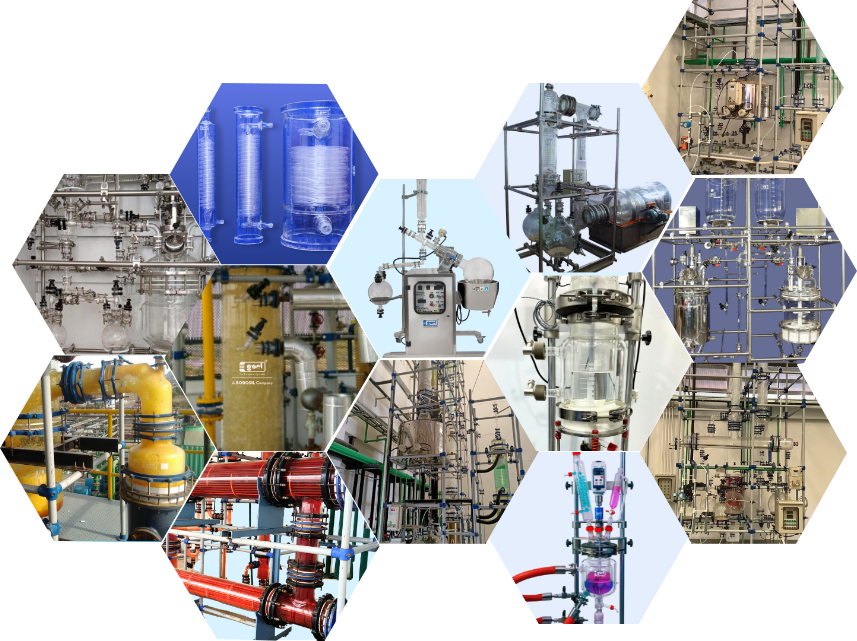
The portfolio includes crystallising dishes, evaporating dishes, Petri dishes (S-line and standard), and drying trays, all made from borosilicate glass and designed for long-term laboratory use.
They are used to slowly evaporate solvents and form crystals in chemical or pharmaceutical workflows. Their wide surface area and shallow depth allow uniform evaporation without interfering with crystal morphology.
Each product line is available in multiple sizes to match application requirements, ranging from 60 mm to 150 mm in Petri dishes, and with varied capacities in evaporation and crystallisation dishes.
Use neutral pH detergents, autoclave at 121°C, and handle them with extreme care to avoid thermal shock. Inspect regularly for damage and replace glassware that shows signs of wear.
Lab glassware dishes are better at withstanding heat and chemicals, can be sterilised in an autoclave, and can be used repeatedly. Plastic dishes are single-use, don’t withstand heat well, and are unsuitable for many analytical procedures. To meet the needs for high temperatures and multiple uses, Borosil Scientific ensures that all its dishes are made of glass.