












Laboratory Flasks

Types of Laboratory Flasks
Different laboratory flasks serve different purposes, and in scientific practice, these distinctions are critical. Borosil Scientific offers a comprehensive range of flasks, each designed to support specific needs in analytical, pharmaceutical, educational, and research settings. Here’s an overview of some of the key types widely used in laboratories today.
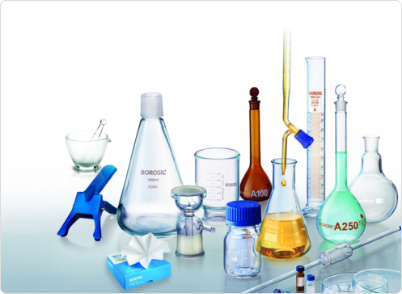
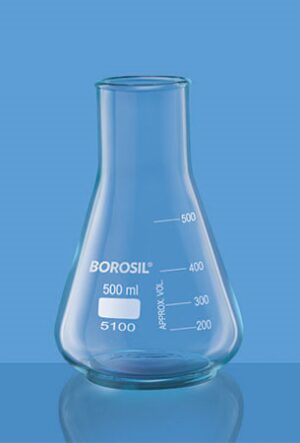
- Erlenmeyer Flask (Conical): Also known as the chemistry conical flask, this is a powerful tool in laboratories. Borosil Scientific’s variants include options with wide mouths, narrow mouths, I/C glass joints, and even amber-tinted versions, which help protect light-sensitive samples.
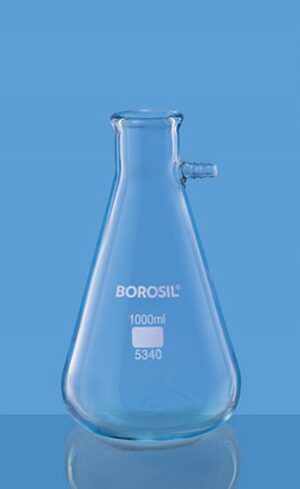
- Filter Flask: Also referred to as a filtration flask, this type includes a sidearm tubulation for vacuum filtration.
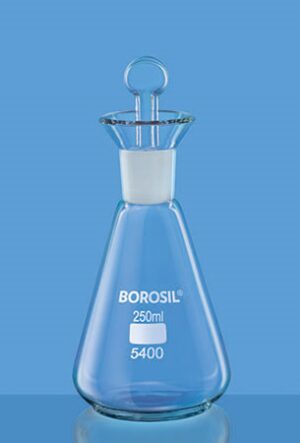
- Iodine Flask: Used for iodometric titrations and reactions involving volatile iodine.
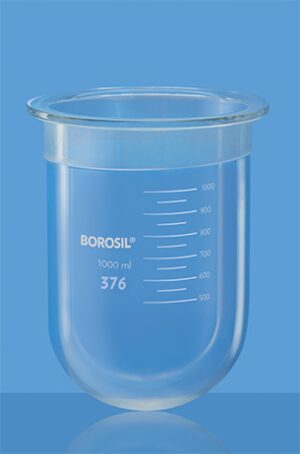
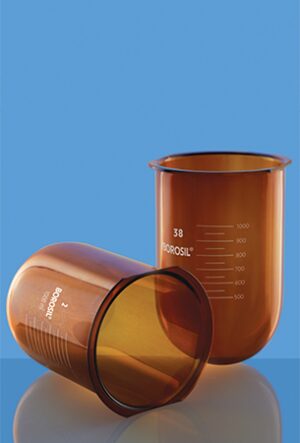
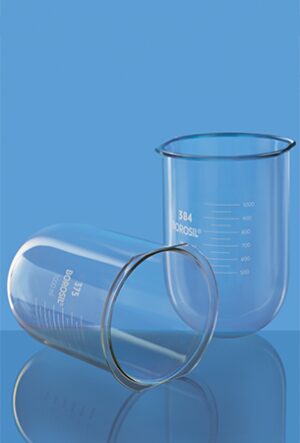
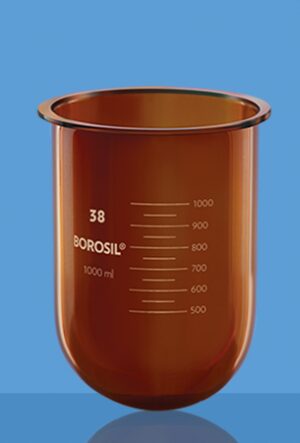
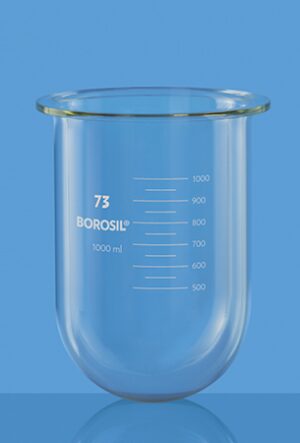
- Dissolution Flasks (E, L, D types): Ideal for pharmaceutical dissolution testing, Borosil Scientific’s dissolution range includes clear and amber versions, all of which conform to USP standards and are available with traceable certificates.
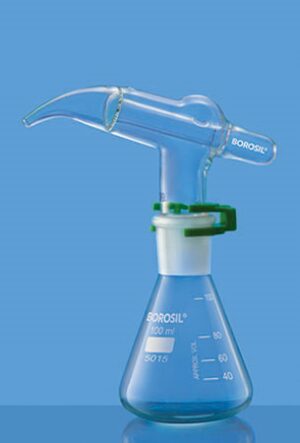
- Tilt Measure: Not exactly a flask in the traditional sense, but the 5015 – Tilt Measure offers high visibility and easy measurement handling for semi-quantitative transfer applications.
These flasks are available in various volumes and glass thicknesses to suit both standard and high-precision requirements.
Key Features of Laboratory Flasks
A well-made flask doesn’t just hold liquid. It resists chemicals, withstands thermal stress, maintains its shape during heating, and ensures minimal leachables. Borosil Scientific lab flasks offer:
- High Chemical Resistance: Made from Borosilicate 3.3 glass, they can withstand most acids, bases, and organic solvents without reacting or degrading.
- Thermal Shock Resistance: The glass is designed for repeated heating and cooling cycles, maintaining stability without cracking. This matters when you’re running reflux reactions or autoclaving equipment.
- Traceable Certification: Dissolution flasks, such as the 4266 – Dissolution L-Flask, Clear, come with USP certification and traceability, which is critical for pharmaceutical validation.
- UV Protection: Amber variants such as 4268 – Dissolution L-Flask, Amber shield samples from photodegradation, a must-have for light-sensitive compounds.
- Interchangeable Components: Glass joints and stoppers are designed to be compatible across systems. Products like the 5020 – Narrow Mouth Erlenmeyer with I/C Joint & Stopper provide a tight fit every time.
| Feature | Borosil Flask Advantage |
| Glass Type | Borosilicate 3.3, USP-compliant |
| Joint Compatibility | Interchangeable glass stoppers and joints |
| Thermal Stability | Withstands sudden temperature changes |
| Certified for Compliance | USP Certificates available for dissolution flasks |
| Variety of Sizes & Shapes | From 25 mL to 1 L, depending on the type |
Why Choose Borosil Scientific Laboratory Flasks?
It’s not just about the glass, it’s about the trust you place in your tools. Every flask from Borosil Scientific is built in ISO-certified plants with a rigorous QC process that includes dimensional inspection, chemical resistance testing, and mechanical durability evaluation.
Whether you’re performing titrations, conducting vacuum filtration, or preparing dissolution samples, you’ll find a Borosil Scientific flask explicitly built for that purpose.
Applications of Lab Flasks in Science
Science lab flasks are used across multiple disciplines and techniques, each with its own functional need. From drug discovery to water testing, these flasks are integral to setting up experiments and ensuring data integrity.
- Pharmaceutical Testing: Dissolution testing, for instance, utilises D, E, or L-shaped flasks, such as the 4265 – Dissolution E-Flask, Clear. The shape provides proper flow and agitation for tablets under test. With USP compliance and certificates, they are ideal for regulatory environments.
- Chemical Synthesis: In organic synthesis or titration labs, conical flasks are frequently used in chemistry for mixing, heating, and holding reaction mixtures.
- Filtration Applications: For vacuum-assisted filtrations, a filtration flask is used with a Büchner funnel. It’s built to withstand negative pressure and offers no compromise during separation procedures.
- Microbial Culture and Fermentation: Baffled-bottom flasks offer improved gas exchange and are commonly used in biotechnology and fermentation laboratories.
- Analytical Chemistry: The 5400 – Iodine Flask is used for titrations involving volatile substances, such as iodine. Its tight-fitting I/C glass stopper prevents vapour loss, ensuring accurate volumetric readings.
Conclusion
Borosil Scientific laboratory flasks combine precision engineering with proven durability to support reliable outcomes across diverse scientific applications. From pharmaceutical dissolution to chemical synthesis, each flask is designed for accuracy, safety, and compliance. Choosing the right flask ensures consistency in experiments and confidence in every result generated.
FAQs
Are Borosil Scientific science lab flasks heat-resistant?
Yes. All science lab flasks from Borosil Scientific are made from high-quality borosilicate glass, specifically type 3.3. This material offers exceptional thermal resistance and is suitable for use in heating, autoclaving, and repeated temperature cycling applications.
What size options are available for Borosil Scientific flasks?
Sizes vary by application. Standard Erlenmeyer flasks are available in sizes ranging from 25 mL to 1000 mL. Filter flasks and dissolution flasks come in specialised volumes based on the method requirements. You can find all technical and ordering specifications in the product documentation.
Is an Erlenmeyer flask the same as a conical flask?
Yes, the terms are used interchangeably. Both refer to flasks with a broad base and a narrow neck, commonly used for mixing and heating. For example, the 5000 – Narrow Mouth with I/C Joint is an Erlenmeyer flask suitable for precise volume control and secure closure.
What is the use of a conical flask in a laboratory?
A chemistry conical flask is used for mixing solutions, heating over burners, and carrying out reactions. Its shape reduces the risk of spills and facilitates swirling during titrations or reactions.
What size options are available for Borosil flasks?
Flask sizes range depending on the model and application. For instance, the Tilt Measure (5015) might come in smaller volumes suited for liquid handling, while dissolution flasks have standardised sizes for regulatory testing. Full ordering info is provided in product PDFs.