








Laboratory Funnels
-

-

6405 – Pressure Equilising Cylindrical Funnel
With Boroflo Stopcock And I/C Glass StopperView Details -
-
-
-

-
-
-
Maintenance Tips for Water Baths
If you take care of lab water baths regularly, the equipment will work the same every time, last longer, and keep samples from getting mixed up.
Recommended Practices:
- Daily checks: Verify water levels before every use. Low water can damage heaters.
- Weekly cleaning: Use non-reactive agents. Avoid abrasives that damage stainless steel interiors.
- Deionised water: This is always preferred to reduce scale formation.
- Temperature validation: Regularly cross-check with calibrated thermometers.
Safety Recommendations:
- Thermostat testing: Engage overheat protection weekly.
- Circuit inspection: Make sure safety circuits are active, especially for oil baths.
- Draining protocol: Always cool before draining; use provided taps (available in 5L+ models).
Borosil Scientific’s oil bath range is built from high-grade SS304 and features mica heaters for uniform heat distribution. A 4-digit 7-segment display enhances user readability, while the external PT-100 sensor offers precise temperature tracking. Safety is built into overheat thermostats and system cut-off features to detect faults.
| Maintenance Area | Frequency | Notes |
| Water Level Check | Daily | Use max/min markers |
| Cleaning | Weekly | Non-abrasive cleaner only |
| Thermostat Testing | Weekly | Especially for high-temp cycles |
| Descaling | Monthly | More often if hard water is used |
Water Bath Temperature Control and Stability
Maintaining consistent temperatures is very important for test reproducibility, reaction control, and sample protection. Borosil Scientific water baths are engineered to deliver precise thermal control, especially critical in regulated labs.
Elemental Water Baths from Borosil Scientific are designed for general-purpose applications, including food testing, dental sample heating, and thermal stability studies. They feature PID controllers for fast heat-up and fine-tuned temperature holding. The compact design saves bench space, and a perforated base plate improves circulation.
For advanced applications, the Premium Circulating Water Baths enable temperature uniformity through integrated magnetic stirrers. These systems deliver ±0.2 °C accuracy at 37°C which is crucial for cell culture and enzyme kinetics. The interface includes digital display panels for temperature, RPM, and timers, as well as USB ports for data logging.
Control Specifications:
- Temp range: Ambient +5 °C to 95 °C
- Accuracy: ±0.2 °C at 37 °C
- Probe: External PT1000 for external media temp tracking
- Display: Digital interface with USB logging
Smart Features:
- Safety cut-offs: Overheat, overcurrent, low water
- User access: Side handles, SS lid with concentric rings
- Thermal insulation: Glasswool-lined chambers
Borosil Scientific’s ultrasonic baths can be used for sonication-based cleaning. Degas modes work better for cleaning because they get rid of gases that have been dissolved in the medium. These baths can be equipped with seamless tanks, mesh baskets, and lids, and they can run for 99 minutes at a time or continuously.
Applications of Laboratory Water Baths
Water baths are used in many different fields for many different things, such as warming reagents, thawing samples, testing for pathogens, and extracting chemicals. Here’s how Borosil Scientific’s products match the needs of different labs:
Routine Lab Applications:
- Sample incubation: Ideal for DNA hybridisation and protein denaturation.
- Reagent warming: Prevents cold shock in sensitive reactions.
- Thawing: Controlled thawing prevents temperature spikes.
Advanced Applications:
- Corrosion testing: High-accuracy circulating water baths are suitable for ASTM tests.
- Food industry: Stability testing of fat, oil, and meat extracts.
- Dental setups: Heating of dental moulds and materials.
| Application | Recommended Unit | Key Feature |
| Enzyme reactions | Circulating Water Bath | ±0.2 °C accuracy |
| Sample cleaning | Ultrasonic Bath | Degas + SS basket |
| Thawing | Oil Bath | External PT-100 sensor |
| Corrosion Testing | Elemental Bath | PID + deep tank |
WLS Series: For labs that require simultaneous heating and stirring, the WLS variant under Borosil Scientific’s Elemental range integrates overhead stirrers. This is suitable for viscosity-based assays and fluid solubility trials.
Each Borosil Scientific water bath, whether oil, ultrasonic, elemental or premium circulating, is built with lab-optimised materials and process consistency in mind. With bench space at a premium and compliance being non-negotiable, these systems meet ISO expectations without compromise.
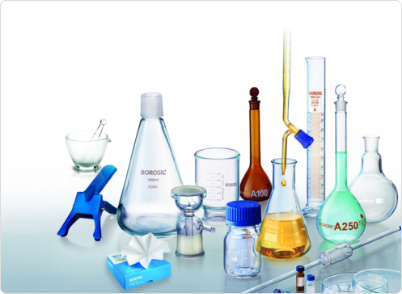
Laboratory funnels help move liquids, powders and mixtures safely and correctly. They also allow you to add chemicals, filter and separate liquids in a controlled way without spilling or losing the sample during regular or specific processes.
A funnel stand keeps funnels in place during liquid transfer or filtration. It keeps your hands free, keeps things aligned and makes it safer when working with solvents, corrosive chemicals, or long filtration processes.
A test funnel is usually used for small-volume transfers into test tubes or narrow vessels. It supports controlled dispensing during analytical testing, sample preparation and micro-scale laboratory workflows.
Dropping, separating, powder, filter and test funnels are some of the different types of funnels used in labs. Each design is made to do a certain job based on the kind of sample, its volume and what it needs to go through.