












Petri Dishes

What is a Petri Dish?
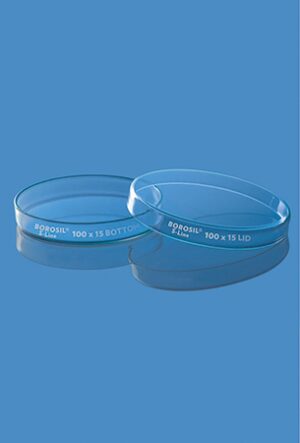
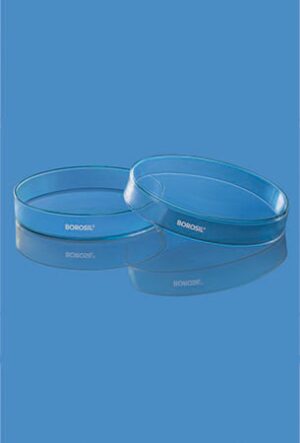
A Petri dish is a shallow, cylindrical container used primarily for culturing microorganisms. Typically consisting of two parts, a flat-bottomed base and a slightly larger lid, it provides a contained space for the growth and observation of microbial cultures.
Petri dishes may look deceptively simple, but their design plays a very important role in the quality and reliability of microbial research. The dish must allow uniform spreading of culture media, withstand sterilisation, and provide an optically clear view of the colonies as they develop.
Types of Petri Dishes
There are two primary types of Petri dishes commonly used in Indian laboratories today: soda-lime glass and borosilicate glass.
| Petri Dish Type | Material | Sterilisation | Reusability | Recommended For |
| S-Line Petri Dish (3165) | Soda Lime Glass | Autoclavable (wet/dry) | Medium | Routine culturing, teaching labs |
| Standard Petri Dish (3160) | 3.3 Borosilicate Glass | High-temperature resistant | High | Research, diagnostics, long-term studies |
The S-Line Petri Dish from Borosil Scientific is made of soda-lime glass. It has long-lasting white enamel printing that makes it easy to tell the lid and base apart. This small detail helps a lot in high-throughput experiments. The Petri Dish, on the other hand, is made of 3.3 borosilicate glass, which stands up to high temperatures and harsh chemicals. Ideal for research applications, it withstands repeated sterilisation and maintains its structural and optical integrity over multiple uses.
Features of Petri Dishes
A high-performance Petri dish is more than just a dish. It should be physically stable, clear, and easy to sterilise. At Borosil Scientific, we make sure that every dish we make has these features.
- White Enamel Marking: The clear markings on the lid and base improve handling efficiency during sorting or pairing.
- Beaded Edges: These improve mechanical strength and reduce chipping risk during washing or stacking.
- Optical Clarity: Both models are manufactured with bubble-free glass, allowing critical observation of culture growth without visual distortion.
- Flat Inner Surface: Makes sure you get uniform distribution of media, reducing inconsistencies during sample placement.
- Autoclave-Ready: Repeated wet or dry sterilisation cycles do not degrade dish integrity, particularly with borosilicate variants.
- Uniform Wall Thickness: This design feature maintains thermal balance and prevents stress fractures.
In addition, the lids are carefully formed to minimise condensation, and the compatibility with standard laboratory sterilisation setups makes them ideal for daily use.
Common Uses of Petri Dishes
In Indian pharmaceutical and biological labs, Petri dishes are standard tools across multiple domains. Here’s how they’re usually used:
- Microbiological Studies: Culturing bacteria and fungi from environmental or clinical samples using agar media.
- Antibiotic Sensitivity Testing: Observing zones of inhibition around antibiotic discs to determine microbial resistance.
- Plant Tissue Culture: Supporting growth media for the regeneration of plant tissues under sterile conditions.
- Environmental Monitoring: Sampling airborne microbes in cleanroom environments.
- Teaching Labs: Demonstrating microbial growth patterns and media preparation techniques in colleges and universities.
It’s not uncommon for a setup to require Petri dishes alongside other essentials, especially in sterile culture rooms where contamination control is critical.
How to Choose the Right Petri Dish?
Selecting the appropriate Petri dish hinges on several operational factors, such as the type of media used, the sterilisation process, the experiment duration, and material preference. For applications requiring frequent autoclaving, chemical resistance, and dimensional stability, borosilicate glass is the material of choice.
| Parameter | S-Line Petri Dish (3165) | Petri Dish (3160) |
| Material | Soda lime glass | 3.3 Borosilicate glass |
| Thermal Resistance | Up to ~150 °C | Up to 500 °C |
| Autoclave Compatibility | Yes | Yes (wet and dry cycles) |
| Reusability | Moderate | High |
| Edge Design | Plain | Beaded rim for extra strength |
| Application Type | Educational, low-risk labs | Pharma QC, microbial R&D |
| Wall Thickness Uniformity | Standard | High precision |
| Sterility Assurance | Requires pre-sterilisation | Withstands repeat sterilisation |
Where studies involve sensitive microbial strains, exacting growth measurements, or long-duration incubations, Borosil Scientific’s 3160 Petri Dish is ideal. For classrooms or preliminary culturing, the 3165 S-Line offers cost-effective utility.
Pairing the right Petri dish ensures smoother workflows, especially when handling viscous media or dispersing additives uniformly across the agar surface.
Proper Handling and Sterilisation Methods
Even the most precisely made Petri dish needs to be handled properly to retain its integrity over time. Borosil Scientific glass Petri dishes are autoclavable, but recommended protocols should be followed:
- Allow dishes to cool inside the autoclave to avoid thermal shock.
- Always try to avoid stacking hot dishes and wait until they reach room temperature.
- Clean using non-abrasive brushes to preserve inner clarity.
- Make sure to use nitrile or latex gloves when handling sterile dishes to avoid contamination.
A lot of sterility breakdowns are caused by human error in handling, not problems with the product. When mixing media, use a glass stirrer rod that has been properly calibrated. To stop condensation from forming, keep lids slightly open while pouring.
Yes, Borosil Scientific’s borosilicate glass Petri dishes (3160) are designed for repeated autoclaving. Soda lime versions (3165) can be reused but may show wear faster over time.
Use dry-heat sterilisation where possible, and avoid pouring overly hot media. Let dishes cool slightly before pouring agar to reduce steam accumulation under the lid.
Yes. Both soda lime and borosilicate dishes allow limited UV exposure. However, long-term exposure may weaken soda lime glass integrity. Borosilicate variants handle it better.
Yes, but only for short-term or one-time use. Plastic lacks thermal stability and optical clarity over time. For precision studies, glass is preferred.