











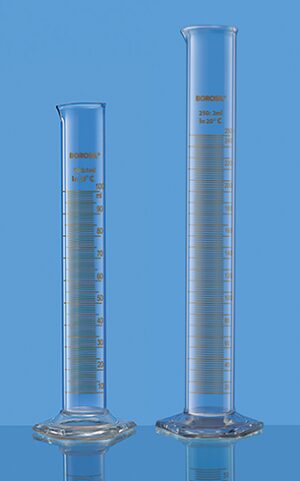
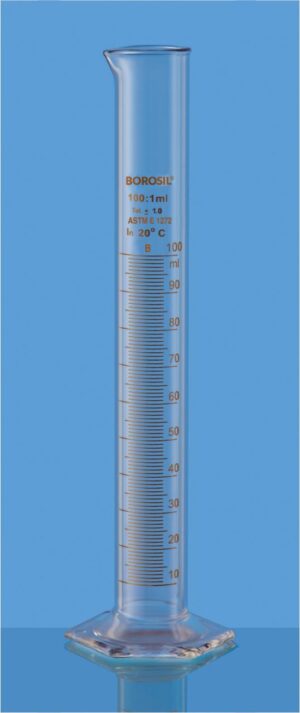
Laboratory Measuring Cylinder

-
-
-
-
-
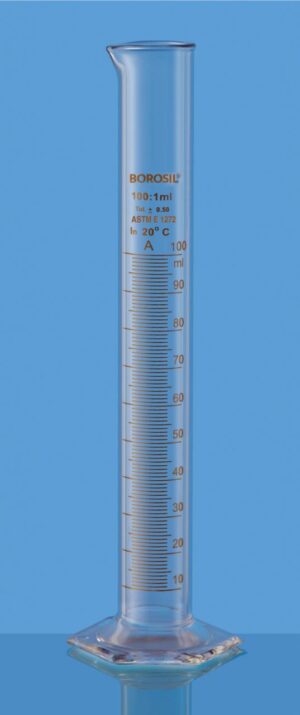
3026 – Cylinders
ASTM, Class A, Hexagonal base, Pour out, with Individual Calibration CertificateView Details -
-
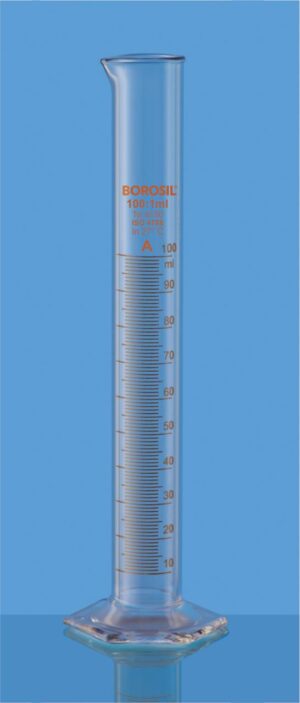
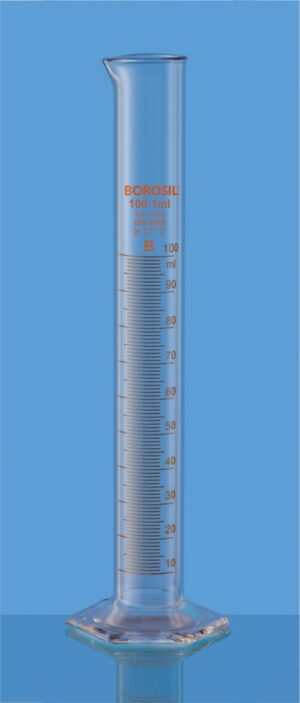
3021 – Cylinders
Class A, Hexagonal base, Pour out, with Individual Calibration CertificateView Details -
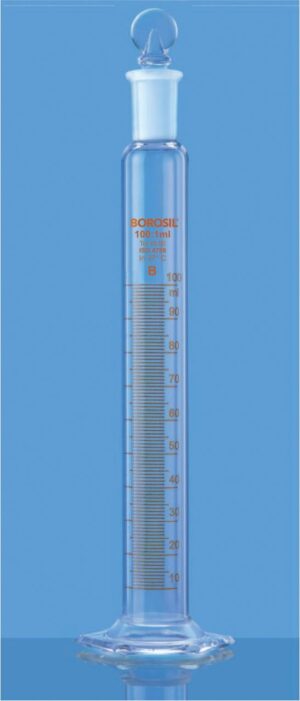
-
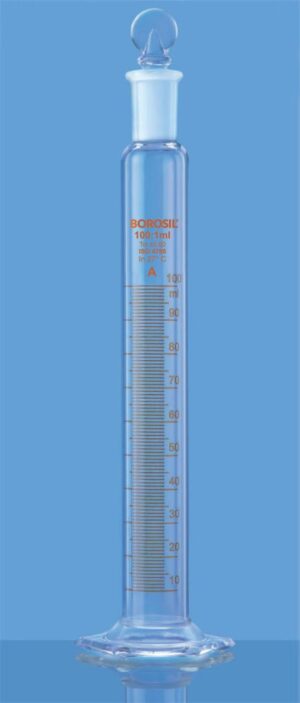
2983 – Cylinders
USP, Class A, Hexagonal Base, with I/C Stopper, with Individual Calibration CertificateView Details
Types of Measuring Cylinders
Measuring cylinders are categorised based on their design, class of accuracy, volume capacity, and functional use. At Borosil Scientific, each variant is manufactured from high-quality borosilicate glass, ensuring chemical resistance, thermal stability, and long-term durability.
| Model No. | Volume Range | Class | Base Type | Stopper/Feature | Certificate |
| 3021 | 10 ml – 1000 ml | A | Hexagonal | Pour out | Individual |
| 3022 | 10 ml – 1000 ml | B | Hexagonal | Pour out | Not included |
| 3026 | 10 ml – 1000 ml | A | Hexagonal | Pour out | Individual |
| 3027 | 10 ml – 1000 ml | B | Hexagonal | Pour out | Not included |
| 2981 | 10 ml – 1000 ml | A | Hexagonal | Interchangeable stopper | Individual |
| 2982 | 10 ml – 1000 ml | B | Hexagonal | Interchangeable stopper | Not included |
| 2983 | 10 ml – 1000 ml | A | Hexagonal | Interchangeable stopper (USP compliant) | Individual |
All Class A models are calibrated individually and are accompanied by a Certificate of Calibration traceable to national standards. The 3026, 3021, 2981, and 2983 cylinders are commonly used in regulated pharmaceutical environments where compliance with GMP and GLP is mandatory.
Special Cylinders
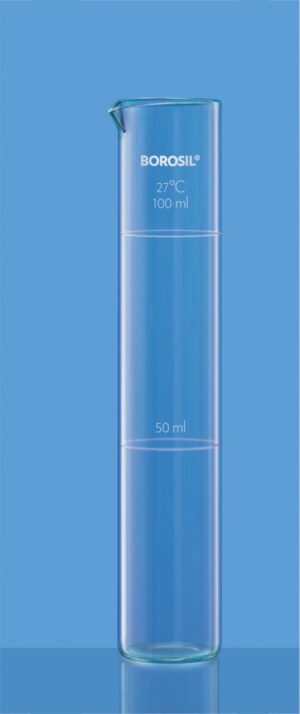
- 2975 – Nessler Cylinders: These tall and narrow (but not graduated) cylinders are used in analytical chemistry for colorimetric comparison.
- 3032 – Tapped Density Cylinder: This is used with a tapped density device to measure the bulk density of powders and granules.
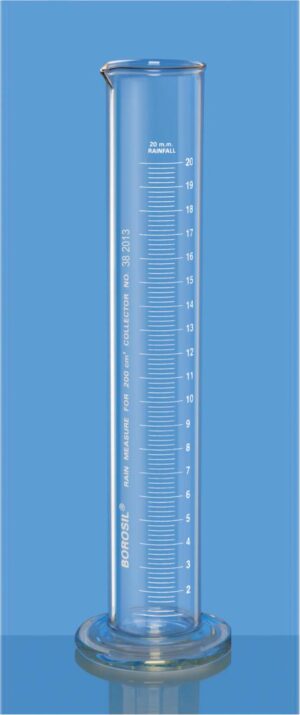
- 3070 – Rain Measure Cylinder: This is calibrated for precipitation collection and meteorological analysis (weather research).
At Borosil Scientific, we provide durable glass alternatives for improved longevity and accuracy under laboratory conditions.
Applications in Chemistry Labs
In R&D labs, QA/QC settings, academic research, and production analysis, the chemistry measuring cylinder is used in a variety of ways. Some of the most common applications are:
- Quantitative Transfers: Before moving liquids to flasks or reaction vessels, measure them carefully.
- Reagent Preparation: Used to make standard solutions and to perform volumetric dilutions.
- Density Determination: It works together with scales for weighing liquids and other mixtures.
- Colour Comparison: With Nessler cylinders, used for water testing and trace metal analysis.
- Powder Characterisation: With tapped density cylinders, especially in formulation labs.
In many cases, the preferred choice for critical work is the Class A 100 ml measuring cylinder, offering a suitable balance between precision and ease of handling. For bulk transfers, the 1000 ml measuring cylinder allows for high-volume measurements without compromising accuracy, especially when equipped with pour-out spouts to minimise loss.
Why Choose Borosil Measuring Cylinders?
Borosil Scientific’s measuring cylinders are manufactured with precision-moulded borosilicate glass 3.3, providing high chemical resistance and minimal thermal expansion. This means they can be used in processes that have acidic or alkaline solutions, as well as changes in temperature, while reactions or storage are happening.
Structural Highlights:
- Hexagonal Base: This provides stability and prevents accidental tipping.
- Graduated Markings: Comes with permanent amber enamel calibrations, resistant to acids and lab solvents.
- Pour Out & Stopper Options: These are available in both open and closed systems.
- Amber Versions: These are available on request, suitable for photosensitive reagents.
- Compliance: Class A cylinders comply with ASTM E1272 and ISO 4788 standards.
Certification & Traceability
All Class A cylinders, like the 3021, 3026, and 2983 models, come with a Certificate of Calibration that mentions a unique lot number. According to ICH Q7 and FDA 21 CFR Part 211, these papers show that the laboratory instruments are working properly.
For analytical procedures such as limit testing, pH verification, and assay preparation, volumetric cylinder accuracy is directly linked to the reliability of the final result.
| Feature | 3021 / 3026 (Class A) | 3022 / 3027 (Class B) |
| Tolerance | ±0.2 ml (100 ml) | ±0.5 ml (100 ml) |
| Certificate | Yes, individual | No |
| Recommended for | GMP labs, QC, analytics | Academic, general use |
| Calibration Standard | ASTM E1272, ISO 4788 | ASTM E1272, ISO 4788 |
In applications involving method validation, using a calibrated lab cylinder eliminates one variable in the chain of measurement uncertainty.
Yes. Models such as 3022 and 3027 are widely used in universities and training institutes. Their Class B tolerance offers suitable accuracy without the need for individual calibration certificates.
The 3032 tapped density cylinder is designed for powder density testing. Used alongside a tapping apparatus, it provides bulk and tapped volume readings, essential for excipient development and pre-formulation studies.
Borosil Scientific offers all standard sizes: 25 ml, 50 ml, 100 ml, 250 ml, 500 ml, and 1000 ml measuring cylinders, available in both Class A and Class B, with or without stoppers.