










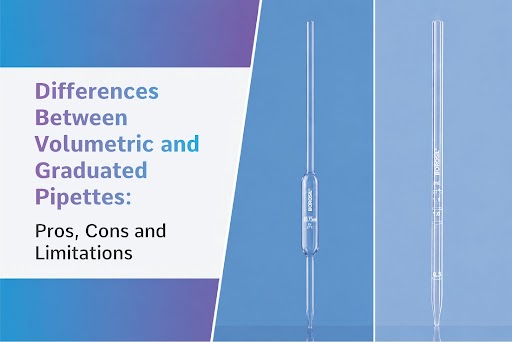
Accurate measurement of liquids is essential in laboratory work, especially when preparing solutions, performing titrations, or transferring samples. Pipettes are key tools for these tasks, but not all pipettes are the same. The two most common types, volumetric pipettes and graduated pipettes, differ in design, accuracy, and use. Volumetric pipettes are built for maximum precision when delivering a single fixed volume, while graduated pipettes offer flexibility by allowing measurement of different volumes. Choosing the right pipette depends on the accuracy required and the nature of the experiment.
A graduated pipette, also called a measuring pipette, consists of a straight glass tube with a tapered tip. The identifying feature of this apparatus is the series of calibration marks along the length of the tube, allowing the user to measure and dispense variable volumes of liquid. At Borosil Scientific, we manufacture these pipettes with heavy walled 3.3 borosilicate glass tubing to support accurate and reliable liquid measurement.
Graduated pipettes include variants such as Mohr pipettes and Serological pipettes. We offer Serological pipettes (e.g., product code 7079) that are calibrated to deliver (TD) the total volume and designed for blow-out operation where applicable. These are available in Class A and Class B accuracy standards. Selected Borosil Scientific Class A pipettes are supplied with individual calibration certificates, supporting traceability and accuracy for critical laboratory applications.
The primary advantage of using a graduated pipette lies in its flexibility. A single pipette can measure different volumes up to its maximum capacity, reducing the need to switch instruments constantly during a procedure.
| Feature | Advantages | Disadvantages |
| Versatility | Capable of dispensing variable volumes (e.g., 1.5 ml, 3.2 ml) using a single unit. | Lower accuracy compared to volumetric counterparts due to the wider bore. |
| Efficiency | Ideal for measuring odd volumes or conducting serial dilutions where speed is prioritised over absolute precision. | Reading errors can occur due to parallax if the meniscus is not aligned correctly with multiple graduation lines. |
| Range | Available in various sizes (e.g., 1 ml to 25 ml), accommodating a broad range of liquid handling needs. | The internal diameter is uniform, which results in a larger surface area for the meniscus, increasing the margin of error. |
A volumetric pipette, also known as a transfer or bulb pipette, is designed to measure and dispense a single, specific volume of liquid with an exceptionally high degree of accuracy. The design typically features a central bulb and a long, narrow neck with a single calibration mark.
At Borosil Scientific, we manufacture volumetric pipettes made of heavy walled 3.3 borosilicate glass tubing that are calibrated To Deliver (TD) a precise volume at a specified temperature (typically 20 °C or 27 °C), depending on the tropical conditions. The narrow neck significantly reduces the error in reading the meniscus, making these instruments the standard for preparing standard solutions and performing titrations where stoichiometry is critical.
The design of the volumetric pipette prioritises precision over flexibility. The narrow tube at the calibration mark ensures that small variations in the liquid level result in negligible volume differences.
| Feature | Advantages | Disadvantages |
| Accuracy | Offers the highest accuracy and precision for liquid transfer, typically meeting Class A tolerances. | Fixed volume limits usability; a 10 ml pipette cannot measure 5 ml or 10.5 ml. |
| Readability | The single calibration mark on a narrow neck minimises meniscus reading errors. | Slower drainage time due to the constricted tip and the need for careful meniscus adjustment. |
| Calibration | Manufactured to defined accuracy tolerances, supporting analytical chemistry applications. | More fragile due to the bulb and long stem construction. |
Understanding the technical distinctions between these two types of glassware is essential for ensuring data quality. The following table outlines the structural and functional differences.
| Parameter | Volumetric Pipette | Graduated Pipette |
| Design Structure | Features a central bulb with a long, narrow neck and a single calibration mark. | Straight tube with uniform diameter and graduation marks along the length. |
| Volume Flexibility | Fixed volume (e.g., exactly 10 ml, 25 ml). | Variable volume (e.g., any volume up to 10 ml in 0.1 ml increments). |
| Accuracy Standard | Higher accuracy with lower tolerance limits is used to prepare standard solutions and perform analytical measurements. | Lower accuracy than volumetric pipettes, suitable for routine dispensing and general laboratory work. |
| Calibration Type | Typically, ‘To Deliver’ (TD) is a single volume. | ‘To Deliver’ (TD), often with blowout requirements for serological types. |
| Primary Use | Analytical chemistry, titrations, and standard solution preparation. | Biology, microbiology, reagent preparation, and serial dilutions. |
The choice between these pipettes depends largely on the specific industry application and the required tolerance levels.
In analytical chemistry and pharmaceutical quality control, volumetric pipettes are indispensable.
In microbiology, cell culture, and general chemistry, the flexibility of graduated pipettes is often more valuable than extreme precision.
Selecting the correct pipette involves analysing the experimental protocol and the acceptable margin of error.
Proper handling ensures the longevity of the glassware and the accuracy of measurements.
The selection of laboratory glassware is a technical decision that directly impacts analytical results. Volumetric pipettes provide the high precision necessary for standardisation and quantitative analysis, while graduated pipettes offer the versatility required for general laboratory procedures and biological applications. At Borosil Scientific, we manufacture both types to stringent quality standards, ensuring that laboratories can access the correct tools for their specific analytical requirements.