









Membrane filters are used across all areas of laboratory practice where clarification, sterilisation, or microbial analysis is required. These filters are not generic consumables; they are precision tools engineered to meet the performance requirements of pharmaceutical, food, water, and analytical testing protocols.
A membrane filter is defined by its pore size, physical structure, and material compatibility. Each parameter contributes to its role in the filtration process, whether for sterile filtration, pre-analytical sample prep, or microbiological testing.
This guide examines the functional role of membrane filters, their working principles, material options, and laboratory-specific use cases.
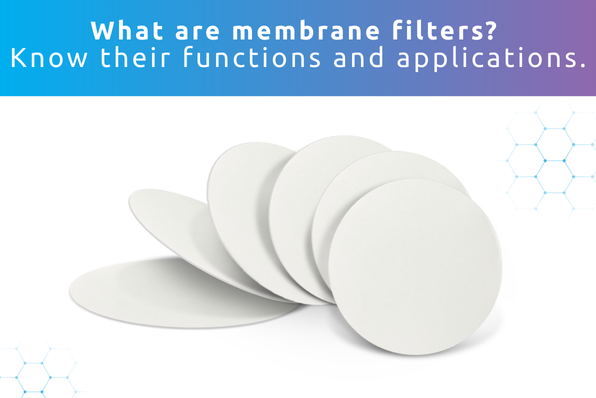
A membrane filter is a microporous polymer matrix that separates particulates or microorganisms from a liquid or gas sample based on pore size exclusion. The filtration mechanism is surface-based: particles larger than the membrane’s pore structure are retained, while filtrates pass through under pressure or vacuum.
Unlike depth filters, which rely on media thickness to capture contaminants, membrane filters are absolute, providing predictable and defined retention. This makes them critical for applications involving regulatory compliance, sterility, or quantitative microbiology.
Ethylene Oxide (EtO) sterilisation is a widely used method for sterilising membrane filters and other temperature-sensitive laboratory or medical products that cannot withstand heat-based methods such as autoclaving.
EtO sterilisation enhances the reliability, safety, and compliance of membrane filters, particularly for sterile filtration, microbial testing, and point-of-use filtration in aseptic environments.
Membranes are not interchangeable. Each material offers specific benefits depending on solvent compatibility, hydrophilicity, protein binding, and sterilisation stability.
| Membrane Type | Properties | Applications |
| Nylon-66 | Hydrophilic, low extractables, compatible with solvents | HPLC sample prep, solvent filtration |
| Cellulose Nitrate | High throughput, high retention, excellent microbial recovery | Sterility testing, water microbiology, and media clarification |
| Gridded CN | Same as above + colony counting grid | Microbial enumeration, water and pharmaceutical QC |
| PTFE | Hydrophobic, highly solvent-resistant | Aggressive chemical filtration, gas sterilisation |
| PES | Low protein binding, high flow | Filtration of biologicals, media, and vaccines |
We at Borosil Scientific currently offer Cellulose Nitrate (plain and gridded) variants under its BOROPure membrane range, covering standard pore sizes of 0.22 µm and 0.45 µm, suited for aqueous, solvent-based, and microbiological applications.
Pore size is not an arbitrary number. It defines retention performance and has a direct impact on compliance and safety. Most laboratories work with one of two options:
The smaller the pore size, the higher the retention but also the slower the flow. Pore validation includes integrity testing, typically using bubble point or diffusion flow methods. All BOROPure membranes from our collection are validated accordingly.
Membrane filters are essential in process control and analytical workflows. Their usage spans pre-analytical steps, in-process checks, and final QC. Here are the common ones:
Filtration of mobile phase solvents is mandatory to protect HPLC columns and ensure baseline stability. Hydrophilic nylon membranes, such as BOROPure Nylon-66, are ideal due to low extractables and solvent resistance. A pore size of 0.45 µm is typically sufficient, unless bacterial removal is also required.
Sterility tests require absolute retention of viable microorganisms. Cellulose nitrate membranes offer high microbial recovery and throughput, making them suitable for routine sterility checks. For compliance, a pore size of 0.22 µm is the minimum required.
Water samples are filtered through gridded cellulose nitrate membranes, then incubated on selective agar to allow colony development. The black grid lines support accurate colony counting. Borosil Scientific’s BOROPure gridded membranes are tested for growth inhibition and microbial recovery to ensure the validity of results.
General-purpose clarification before spectrophotometry, colourimetry, or sample injection into any analytical instrument often uses 0.45 µm membranes. Material compatibility with sample composition determines whether cellulose nitrate or nylon is preferred.
Below is a reference summary of Borosil Scientific’s current offerings in membrane filters.
| Product Name | Code | Material | Pore Sizes | Diameter | Key Uses |
| BOROPure Nylon-66 | 5347 | Nylon-66 | 0.22 µm, 0.45 µm | 47 mm | HPLC solvents, aqueous sample clarification |
| BOROPure CN (Plain) | 5147 | Cellulose Nitrate | 0.22 µm, 0.45 µm | 47 mm | Media sterilisation, buffer prep, sterility testing |
| BOROPure CN (Gridded) | 5247 | Cellulose Nitrate | 0.22 µm, 0.45 µm | 47 mm | Water and product microbiology, microbial colony counting |
All filters are autoclavable at 121°C for 30 minutes, tested for membrane integrity, extractables, heat stability, and particulate release. Gridded types are tested additionally for growth inhibition and microbial challenge.
For GMP or GLP-compliant workflows, membrane filters must undergo:
BOROPure membranes are batch-certified with traceability and are used in labs adhering to Indian Pharmacopoeia (IP), United States Pharmacopoeia (USP), and WHO protocols.
| Do | Don’t |
| Match pore size to the application’s microbial or particle profile | Assume 0.45 µm can substitute 0.22 µm in sterile applications |
| Confirm solvent compatibility with the membrane material | Use hydrophobic membranes for aqueous solutions without pre-wetting |
| Validate membrane lots in critical test setups | Mix different membranes within the same test without validation |
Membrane filters are not additional lab supplies; they are core functional tools required for accurate, reproducible, and compliant filtration. Whether you’re prepping samples for chromatography, running microbial counts, or conducting final product sterility checks, the right membrane, when chosen for its pore size, retention accuracy, and chemical compatibility, can directly impact the outcome.
At Borosil Scientific, our BOROPure membrane filters are manufactured and tested to meet the expectations of laboratories working under regulatory standards. From high-flow cellulose nitrate to chemically resistant nylon membranes, we offer lab-ready, QC-tested solutions for critical filtration processes.
For material compatibility data sheets or membrane selection support, contact our technical team or authorised channel partner.