










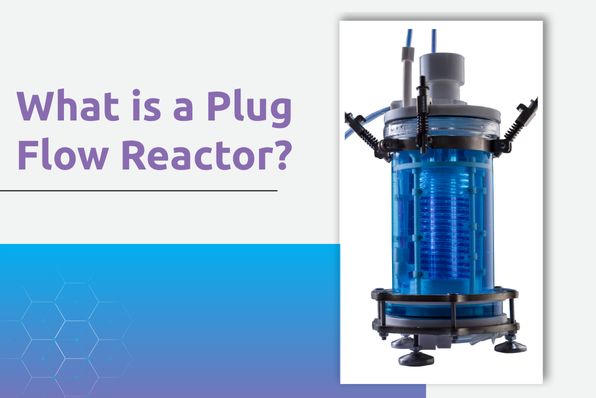
In chemical engineering, a plug flow reactor (PFR), also referred to as a tubular reactor, is a model used to describe the behaviour of reactants flowing through a cylindrical pipe or tube.
Unlike batch or stirred tank reactors, PFRs assume that fluid elements move through the reactor as discrete “plugs” with no back-mixing. Each infinitesimal volume element progresses along the reactor length with uniform composition. This model is critical for predicting reaction outcomes in systems where residence time and reaction kinetics must be precisely managed.
Plug flow conditions are particularly relevant when scaling up laboratory processes to pilot or industrial scale, especially in continuous manufacturing settings involving exothermic or catalytic reactions.
To understand the functioning of a plug flow reactor, you must focus on the key features that define its operation:
The plug flow reactor model is foundational in various process development applications. It provides high space-time yields and sharp residence time distributions, making it valuable for:
| Application Area | Use Case Example | Key Benefit |
| Catalytic Reactions | Hydrogenation or dehydrogenation | Maximised catalyst contact time |
| Petrochemicals | Cracking or reforming reactions | High throughput with reduced side reactions |
| Pharmaceutical API Dev | Continuous synthesis of intermediates | Predictable reaction kinetics |
| Polymerisation | Formation of low molecular weight polymers | Control over molecular distribution |
Although a PFR is typically a tubular metal or glass assembly in full-scale settings, Borosil Scientific supplies a wide range of laboratory-grade reaction tools used to simulate plug flow behaviour in segmented or modular forms.
Made from 3.3 low-expansion borosilicate glass (ASTM E438 Type I, Class A), these offer high thermal and chemical resistance. Used in custom setups for studying continuous flow reactions. Plug flow systems are complex to design and hard to turn into working hardware. Next, many setups are one-off. Then, the lab rarely needs to match off-the-shelf parts. Ultimately, this requires careful design and thorough testing before production.
For photochemical plug-flow experiments, these glass coils can be paired with LED or mercury lamp housings to create efficient photo-flow reactors. Borosil Scientific’s high-transparency borosilicate glass ensures uniform light penetration and reliable performance during UV or visible-light-driven reactions.
Used at feed or collection points. Flasks are compliant with ISO 3585 and USP Type I standards, ensuring dimensional accuracy and inertness during continuous liquid handling.
For flow control, Borosil Scientific’s interchangeable standard taper joint glassware (I/C joints) enables integration with dropping funnels, condensers, and inline filters, which are critical for maintaining flow regimes.
Enable the connection of multiple reagent lines, pressure sensors, or temperature probes. Useful during transient residence time experiments or when measuring plug dispersion.
Maintaining consistent heat along the reactor length is very important. PFRs are inherently efficient in heat transfer when externally jacketed or coiled. At lab scale, Borosil Scientific’s round-bottom flasks, used with heating mantles or oil baths, provide localised temperature control that mimics the axial profiles seen in pilot-scale tubular reactors.
Where isothermal conditions are required, condenser attachments fitted with controlled water or glycol lines ensure vapour return without mass loss, simulating the closed-loop condensation often used in high-temperature continuous systems. Many flow applications need first-time product development. Then, engineers design new coil geometries, jackets, or joint assemblies tailored to unique chemistries. This is not a repeatable, standard reactor build. It needs iteration, prototyping, and close teamwork.
It is important to contextualise the PFR model against other reactor types:
| Parameter | Plug Flow Reactor | Continuous Stirred Tank Reactor (CSTR) |
| Flow Pattern | Unidirectional, no back-mixing | Complete mixing, uniform concentration |
| Conversion per unit volume | Higher for first-order reactions | Lower in comparison |
| Modelling Complexity | Moderate, kinetic integration | Simplified due to homogeneity |
| Residence Time Distribution | Narrow (ideal for scale-up) | Broad distribution |
Despite its analytical strengths, PFR systems require strict flow control and maintenance of laminar conditions. At lab scale, this often necessitates auxiliary equipment such as peristaltic pumps, back-pressure regulators, and real-time flow sensors, many of which can be connected via Borosil Scientific’s modular jointware systems.
While reactors remain the primary units, success depends on tight control of upstream and downstream variables. Borosil Scientific supports the following auxiliary equipment:
| Accessory | Function | Material Specification |
| Dropping Funnels | Metered reagent input | Borosilicate, with PTFE stopcock |
| Liebig/Allihn Condensers | Vapour condensation along the column | Jointed glass, for vertical/horizontal use |
| Vacuum Adapters | Outlet connections for maintaining flow pressure | Tapered cone joint with bent hose adapter |
| Receiver Flasks | Collect the product under cooling or vacuum | Wide range of capacities, graduated |
These components, assembled with precision joint work, allow PFR simulations to be executed with repeatability and tight process control, especially when managing reaction parameters such as residence time, flow rate, or exothermicity.
Even in labs where commercial PFR systems are unavailable, process chemists and R&D personnel conduct critical studies using these modular systems. Typical application areas include:
| Feature | Batch Setup | Plug Flow Setup (Lab) |
| Reaction Control | Time and temperature-based | Time, temperature, and flow-based |
| Reaction Uniformity | Entire volume at once | Gradual conversion along the reactor |
| Equipment Use | Round bottom flask + stirrer | Coiled glass, adapters, multineck |
| Scale-up Utility | Moderate | High for flow-based processes |
While the market availability of commercial plug-flow reactors is concentrated among flow chemistry OEMs, laboratory development still relies heavily on the glassware ecosystem that enables experimentation at a granular level. Borosil Scientific provides industry-standard, certified, and chemically inert tools that make such investigations possible.
From round-bottom flasks to modular condensers and taper joint assemblies, our catalogue is designed to support the incremental adoption of flow chemistry practices, including the principles behind plug flow modelling.
If you’re looking to standardise or prototype plug flow investigations in your R&D workflows, we at Borosil Scientific encourage you to explore our extensive product range. Backed by ISO-certified manufacturing and engineered to meet international glassware standards, our solutions are built to perform consistently, safely, and precisely.