







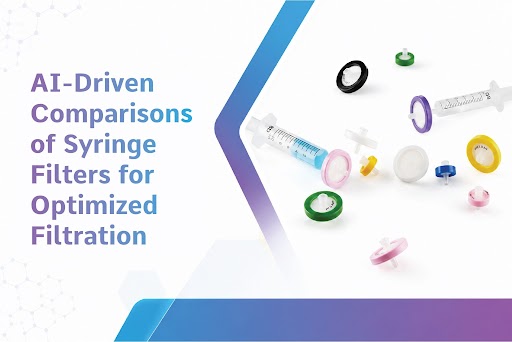
Analytical laboratories rely heavily on the purity and integrity of samples to generate accurate data. High-performance liquid chromatography (HPLC), ion chromatography (IC) and other sensitive analytical techniques require samples free from particulates that could damage expensive columns or interfere with detection. Sample filtration is the critical step that ensures this purity. However, selecting the correct filter from the vast array of available membrane materials, pore sizes and diameters is often complex.
The integration of AI in lab automation offers a structured, data-driven approach to this selection process. By analysing chemical compatibility charts, particulate load data and analyte properties, algorithmic comparisons reduce human error and optimise laboratory workflows. At Borosil Scientific, we provide the precise, specification-backed filtration solutions necessary to support these advanced selection methodologies.
Syringe filters serve as the final barrier before sample injection. Their primary function is to remove particulate matter that might precipitate inside the column or block the system capillaries.
In HPLC applications, column protection is paramount. Particulates can lead to increased backpressure, split peaks and reduced column life. In dissolution testing, filtration ensures that the undissolved dosage form does not enter the analysis stream, which would skew concentration results. The selection of a syringe filter is not merely about size; it involves a complex matrix of variables, including solvent compatibility, extractables profile and analyte binding.
The traditional method of selecting a syringe filter involves manually cross-referencing compatibility tables and relying on historical lab protocols. This manual approach is prone to errors, particularly when working with novel solvent mixtures or sensitive biological samples.
AI in lab automation alters this paradigm by utilising logic-based algorithms to compare thousands of filter specifications against experimental parameters instantly. Artificial Intelligence does not guess; it processes specific input data, solvent type, pH, temperature and required flow rate and matches it against a database of membrane characteristics.
For example, an AI algorithm can identify that a specific peptide sample requires a low-protein-binding membrane. It simultaneously verifies that the mobile phase (perhaps a mixture of Acetonitrile and Water) is compatible with the filter housing and membrane. This dual-layer verification ensures that the chosen filter will not degrade, leach extractables, or adsorb the target analyte.
When algorithms or technicians compare syringe filters, specific parameters dictate the suitability of the product. Our products meet strict manufacturing standards, providing the consistent data points required for accurate comparison.
The choice of pore size is determined by the particle size of the column packing material and the nature of the sample.
| Pore Size | Primary Application | Recommended For |
| 0.22 µm | UHPLC, HPLC (columns < 3 µm particles) | Sterilisation, removal of fine bacteria and particulates. |
| 0.45 µm | Standard HPLC, General Filtration | Clarification of viscous samples, pre-filtration. |
| 1.0 µm + | Pre-filtration | High particulate load samples (often used with glass fibre pre-filters). |
Filter diameter influences filtration efficiency and the amount of liquid retained within the filter after use. In AI in lab automation, diameter is evaluated alongside pore size and membrane material to balance sample recovery, filtration speed and ease of operation. Smaller diameter filters are typically selected when working with limited sample volumes, as they help minimise sample loss, while larger diameter filters provide increased filtration area for higher-volume or faster filtration requirements.
Our syringe filters are available in diameters such as 13 mm and 25 mm, allowing laboratories to select an appropriate configuration based on their application needs and workflow requirements.
The most common cause of filtration failure is chemical incompatibility. If a solvent attacks the membrane, it can cause the filter to dissolve or release oligomers into the filtrate. AI-driven comparisons utilise rigid chemical resistance matrices to prevent such occurrences.
The following table outlines standard membrane types and their specific compatibilities.
| Membrane Material | Chemical Compatibility | General Characteristics | Common Applications |
| Nylon | Broad compatibility with aqueous and organic solvents | Hydrophilic membrane | General laboratory filtration, buffered solutions |
| PTFE (Hydrophobic) | Compatible with aggressive organic solvents, acids and bases | Hydrophobic membrane with high chemical resistance | Organic solvent filtration, venting applications |
| PVDF | Compatible with aqueous solutions, alcohols and mild solvents | Hydrophilic membrane | Biological and general laboratory filtration |
| PES | Compatible with aqueous solutions | Hydrophilic membrane designed for efficient filtration | Filtration of buffers and aqueous samples |
Reliable output from any comparison tool depends on the quality of the input data. We ensure that all filtration products meet defined specifications regarding effective filtration area (EFA), maximum operating pressure and bubble point integrity.
When evaluating filters, the following methodology ensures optimised results:
At Borosil Scientific, we provide detailed documentation and e‑catalogues that serve as the foundational data for these comparisons, helping users verify that product specifications align with their application requirements.
A pharmaceutical quality control laboratory faced frequent HPLC shutdowns due to high backpressure. The root cause was identified as the use of incorrect syringe filters during sample filtration. The lab was using 0.45 µm Nylon filters for a formulation containing a viscous binder. By analysing the particle distribution and viscosity, the protocol was switched to a Borosil Scientific-compatible configuration using a glass fibre pre-filter followed by a 0.22 µm PVDF membrane. This change reduced backpressure events by 60% and extended column life.
A research facility noted inconsistent protein recovery rates during assays. The investigation revealed that the team used standard Nylon filters, which possess high protein-binding characteristics. Following a structured comparison of membrane properties, the lab transitioned to PVDF membranes. This adjustment resulted in a 15% increase in analyte recovery, significantly improving the accuracy of their quantification.
At Borosil Scientific, we understand the rigorous demands of the modern laboratory. Whether for routine clarification or critical analysis, the need for consistency is absolute.
By combining high-quality filtration consumables with structured, data-driven selection processes, laboratories can ensure operational efficiency and data accuracy.
Selecting the correct filtration consumables is critical for ensuring precise analytical results and operational reliability. We at Borosil Scientific provide high-quality, traceable materials manufactured to international standards, enabling laboratories to address diverse chemical compatibilities with confidence. By utilising standardised selection processes and technical-grade products, laboratories achieve long-term research consistency and regulatory compliance. We continue to provide structured solutions designed for the exact specifications of modern laboratory environments.