








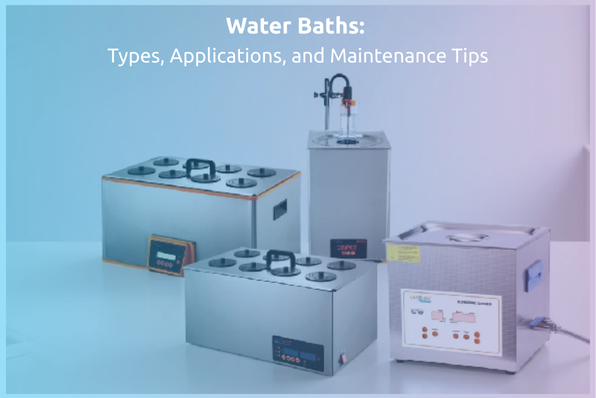
Temperature uniformity plays a vital role in lab experiments, from thawing biological samples to conducting enzyme reactions. A water bath in laboratory settings ensures controlled, repeatable heating without exposing samples to direct flame or overheating. Choosing the right model, however, depends on what the application demands, whether that’s precise circulation, integrated stirring, or basic heating for everyday use.
Laboratories use different types of water baths depending on the application, temperature requirements, and workflow. Understanding these variations helps in selecting the right water bath, along with knowing their use cases across sectors, tips for maintaining optimal performance, and installation considerations.
Used when temperature uniformity across the entire tank is non-negotiable, circulating water baths are designed for consistency.
How it works: These units feature a built-in stirring mechanism, usually magnetic, that continuously moves the heated water to avoid hot or cold spots.
Best used for:
Borosil Scientific’s circulating water bath WBP Series uses a magnetic stirrer to maintain temperature with high precision. Our models offer consistent results even in applications that run for hours, making them suitable for controlled environments like GLP- or GMP-compliant labs.
Constant Temperature baths -. The heating element warms the water evenly enough for routine lab tasks through convection..
Common applications:
At Borosil Scientific, we offer the Elemental Series WLC Series, which is compact, easy to operate, and ideal for multi-user environments. It includes PID temperature control for better accuracy, even without active circulation.
Sometimes, the sample, not just the water, needs movement. That’s where water baths with overhead stirrers come in. These are especially useful in media preparation or when dissolving powders in heat-sensitive liquids.
Borosil Scientific’s WLS variant includes an overhead stirrer integrated into the water bath, allowing labs to heat and mix simultaneously, with stable temperature control and minimal user input.
Each lab sector uses water baths differently, depending on temperature control needs and regulatory expectations.
| Sector | Typical Application | Suggested Bath Type |
| Pharmaceuticals | Dissolution testing, stability studies | Circulating (e.g., WBP) |
| Biotech | Enzyme reactions, nucleic acid workflows | Circulating or Stirring (WBP/WLS) |
| Food & Beverage | Microbial incubation, shelf-life testing | General Purpose (e.g., WLC) |
| Academic/Teaching | Demonstrations, routine heating | General Purpose |
| Dental Labs | Wax softening, water heating | General Purpose |
| Chemical R&D | Heating during reactions | Stirring Baths (e.g., WLS) |
Even a well-built water bath needs regular attention. Preventive care ensures temperature consistency, avoids contamination, and extends equipment life.
At Borosil Scientific, we have designed with cleaning in mind; rounded tank corners and stainless steel interiors allow easier maintenance and reduce biofilm build-up.
To get the most out of your equipment, placement and setup matter just as much as performance specs.
Even the most reliable water bath can underperform or fail if handled incorrectly. Simple operational errors, often unintentional, can lead to contamination, inconsistent results, or equipment damage. The table below highlights common user mistakes and practical steps to avoid them.
| Mistake | Result | Prevention Tip |
| Using tap water | Causes scale, poor heat transfer | Always use distilled/deionised water |
| Leaving the lid open | Inconsistent temperatures, evaporation | Keep the lid closed when not inserting/removing items |
| Direct sample contact | Corrosion or contamination of the tank | Seal all containers before immersion |
| Running the bath dry | Overheating or heater failure | Monitor levels, use models with low-water cut-off |
| Skipping cleaning | Algae, biofilm, microbial build-up | Set a regular cleaning routine |
Energy efficiency and regulatory readiness are often overlooked but are crucial for long-term lab operations.
A water bath in laboratory is not just a heating device; it’s a process control tool. Whether you’re incubating sensitive biological material or preparing reagents for high-throughput workflows, the right type of water bath, installed and maintained correctly, ensures accuracy, safety, and reproducibility.
At Borosil Scientific, we offer models tailored for both high-precision applications and daily lab routines. Their circulating, general-purpose, and stirring-enabled baths reflect real laboratory needs, supporting controlled research environments without overengineering the solution.