








Lab glassware plays a key role in the day-to-day work, from pharma labs and QC setups to production plants. And among all the tools, beakers are easily one of the most commonly used.
Beakers serve multiple roles: heating, mixing, holding, and decanting liquids. But while they may appear simple, their variations serve highly specific functions.
If you’re working in a lab, as a university student or a technician in a pharma plant, it helps to know the different types of beakers and glassware you’ll be using. In this post, we’ll go over the main types, what they’re used for, and how to pick the right one for your work.
Beakers handle liquids in different conditions in a lab. It could be heating, mixing, or running reactions. As a result, things like build quality, thermal resistance, and design really matter.
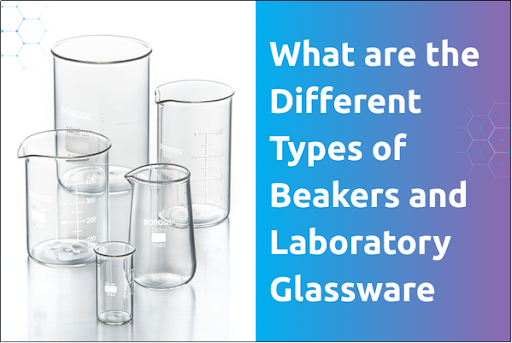
You’ll find beakers in tall and low forms, with or without spouts, and even in specialised shapes like the conical (Phillip) type. Each style serves a specific purpose, especially in labs where precision and consistency are key.
Borosil Scientific is well recognised across Indian laboratories for a dependable range of scientific glassware, including beakers. Each product is made from low-expansion 3.3 borosilicate glass, known for its strength, durability, and excellent resistance to thermal stress.
Below is a structured comparison of the primary beaker types manufactured by Borosil Scientific:
| Beaker Type | Spout | Capacity (ml) | Use Case |
| Low Form Beaker | Yes | 5, 10, 25, 50, 100, 150, 250, 400, 500, 600, 800, 1000, 2000, 3000, 5000, 10000 | General mixing, heating |
| Tall Form Beaker | Yes | 50, 100, 150, 250, 500, 600, 800, 1000 | Heating, titration |
| Tall Form Beaker | No | 50, 100, 150, 250, 500, 600, 800, 1000 | Heating, titration |
| Conical Beaker (Philip) | Yes | 250, 500 | Measuring, mixing, containment, decanting |
Let’s take a detailed look at the structure and applications of different types of lab beakers.
Structure and Purpose: This is a standard laboratory beaker with a wide mouth and shorter height. It’s commonly used across educational labs, industrial R&D units, and quality testing labs for general tasks.
Structure and Purpose: The tall form design improves the separation of the substance being heated from its external medium. Since the height allows for vertical burette access without spilling liquid, these beakers find use in titrations.
Structure and Purpose: This variation doesn’t have the spout, which makes it suitable for applications where containment is more important than dispensing. Often selected for reaction containment, chemical digestion, or thermal stability testing.
Common Use Cases:
Structure and Purpose: The conical (Phillip) beaker stands out due to its tapering mouth and broader base. This unique shape with a narrow opening helps reduce contamination. They are useful for decanting, measuring, and holding.
All beakers from Borosil Scientific are made of 3.3 borosilicate glass. This material is internationally recognised for:
These characteristics become critical for lab personnel working with processes involving high temperatures or volatile materials.
Different applications require different beaker specifications. Here’s a practical guide to selecting the most suitable beaker type:
| Application | Recommended Beaker | Reason |
| Basic heating and mixing | Low Form | Stable and easy to handle |
| Heating in a controlled water bath | Tall Form | Height allows better insulation and handling |
| Reaction containment | Tall Form without Spout | No spout limits exposure |
| Precision pouring and decanting | Conical Beaker (Philip) | Narrow mouth and shape ensure controlled transfer |
| Titration processes | Tall Form | Scale visibility and form fit the procedure |
| Avoiding contamination during heating | Tall Form without Spout | No spout reduces evaporation and contamination risk |
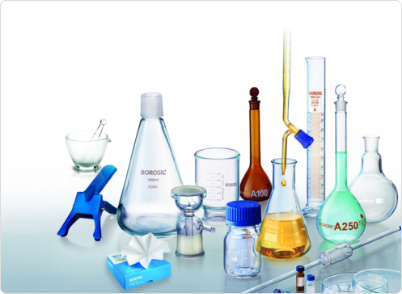
While the focus remains on types of beakers, it’s worth touching on other essential glassware categories to provide context:
It’s important to distinguish these from beakers, which are optimised for general use, not for volumetric precision.
Beakers and other laboratory glassware are durable, but poor handling shortens their life. Here are a few best practices for labs using Borosil Scientific glassware:
These steps preserve calibration, structure, and safety, especially important when working with volatile or corrosive substances.
Choosing the right beaker can directly affect the accuracy, efficiency, and safety of your work. Smoother lab workflows, improved control, and decreased contamination can all be achieved with the correct beaker shape and design. At Borosil Scientific, our beakers are made from low-expansion 3.3 borosilicate glass for durability and thermal stability.
Our aim is to provide scientifically accurate and technically reliable tools that meet the demands of everyday lab work. You can explore our full beaker catalogue or reach out to one of our technical specialists to find the best fit for your specific application.