











Laboratory Cones & Sockets
Types of Laboratory Cones & Sockets
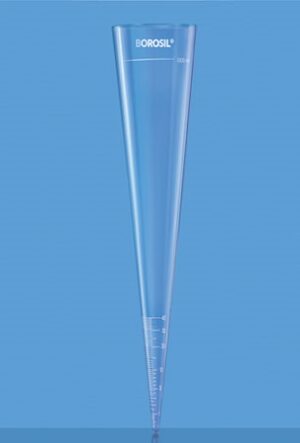
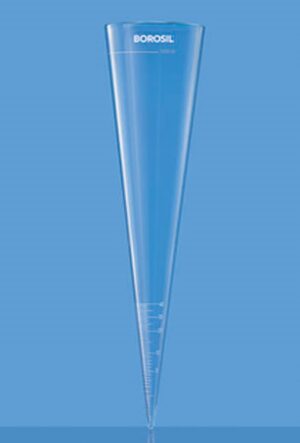
Borosil Scientific manufactures Imhoff cones from 3.3 borosilicate glass, a material chosen for its chemical resistance and thermal stability. The primary distinction between the available models lies in the design of the tip. The graduated markings on these cones are essential for quantifying sediment accumulation over a set period.
There are two primary configurations for the Imhoff cone:
- Blunt Tip (Model 2180): This design features a rounded or flattened bottom at the very tip of the cone.
- Sharp Tip (Model 2160): This design features a pointed bottom, allowing for high precision when reading small volumes of sediment.
The table below outlines the specifications for these models as per the Borosil Scientific e-Catalogue.
Comparison of Borosil Scientific Imhoff Cone Models
| Specification | Model 2180 (Blunt Tip) | Model 2160 (Sharp Tip) |
| Material | 3.3 Borosilicate Glass | 3.3 Borosilicate Glass |
| Capacity | 1000 ml | 1000 ml |
| Graduation | Graduated from 0–1 ml in 0.1 ml divisions, 1–10 ml in 0.5 ml divisions, 10–40 ml in 1 ml divisions, also marked at 1000 ml | Graduated from 0–1 ml in 0.1 ml divisions, 1–10 ml in 0.5 ml divisions, 10–40 ml in 1 ml divisions, also marked at 1000 ml |
| Tip Design | Blunt | Sharp |
| Quantity Per Case | 1 | 1 |
Applications of Types of Laboratory Cones & Sockets
The application of an Imhoff cone is primarily driven by the need to measure settleable solids in surface water, saline water, domestic wastewater, and industrial wastewater. The conical shape is critical as it funnels settling particles to the bottom, allowing for a volumetric reading of the sludge or sediment.
1. Water and Wastewater Treatment
The most common application is determining the volume of settleable solids. The Imhoff cone is filled with a litre of the liquid sample. After a defined settling period as specified by standard testing protocols, the volume of the sediment at the bottom is recorded. This data helps assess the load on primary sedimentation tanks in treatment plants.
2. Environmental Monitoring
In environmental science, these cones assist in analysing surface water quality by measuring the sediment load, which can indicate erosion upstream or pollution levels.
3. Selection Based on Tip Design
The choice between a blunt or sharp tip depends on the nature of the sediment and the required reading accuracy at low volumes.
- Sharp Tip (Model 2160): This is generally preferred when the expected volume of sediment is small. The fine point allows for better resolution and readability of minute quantities of solids.
- Blunt Tip (Model 2180): This model is robust and suitable for general sedimentation tests where extremely low-volume precision at the absolute tip is less critical than durability or ease of cleaning.
By understanding the applications and selecting the right Imhoff cone design, users can ensure accurate and reliable measurements for a wide range of water and wastewater analysis needs.
Why Choose Borosil Scientific Types of Laboratory Cones & Sockets?
Selecting the correct laboratory glassware ensures data reliability and safety. Borosil Scientific Imhoff cones are engineered to meet the rigorous demands of analytical testing.
- Material Integrity: Constructed from 3.3 borosilicate glass, these cones offer high resistance to chemical attack from aggressive wastewater samples. This helps minimise the risk of chemical interaction that could alter the sample or the sediment volume.
- Clarity and Readability: The glass provides high transparency, which is essential for observing the settling process and distinguishing the sediment level from the liquid supernatant. The graduations are permanent and legible.
- Thermal Durability: While sedimentation tests are often conducted at ambient temperatures, the use of borosilicate glass ensures the cones can withstand standard laboratory sterilisation methods if required between uses.
These features collectively ensure that Borosil Scientific Imhoff cones provide reliable and repeatable results for sedimentation analysis.
Sharp tip cones (Model 2160) provide higher resolution for small sediment volumes, while blunt tip cones (Model 2180) are more robust for general usage.
Yes, Borosil Scientific glassware made from 3.3 borosilicate glass is autoclavable. Refer to the product brochure for proper sterilisation care instructions.
Both the 2160 (sharp tip) and 2180 (blunt tip) models have a 1000 ml capacity, as per Borosil Scientific’s product listings.
Imhoff cones are primarily intended for sedimentation testing. While they can be sterilised, they are not designed as primary vessels for microbiological culturing.
The conical design improves accuracy for small sediment volumes. Check Borosil Scientific’s e-Catalogue for specific graduation intervals and tolerance data.