








The reliability of environmental testing is based on the instruments used for its execution. Laboratories that work with water quality, soil health, air monitoring, and effluent discharge depend on very sensitive instruments. Before the analytical phase, each sample must undergo preparatory procedures such as digestion, filtration, distillation, and evaporation, during which the risk of contamination increases, and this is where the choice of glassware is crucial.
Quartz glassware and sintered glass products aren’t just accessories; they directly influence the reliability of test results. In this post, we will explore how these materials support environmental labs, with specific insights into how Borosil Scientific designs tools to meet those standards.
Environmental testing often involves ultra-trace concentrations, measured in parts per billion or lower. At this level, even minuscule leaching or contamination from vessels can significantly impact the results. Quartz offers a non-reactive, high-purity alternative to borosilicate, especially in workflows involving:
Borosil Scientific’s Mono Quartz Distillation Units and Quartz Cabinet Double Distillation systems are widely used in effluent and groundwater testing labs due to their inert behaviour and pyrogen-free water output.
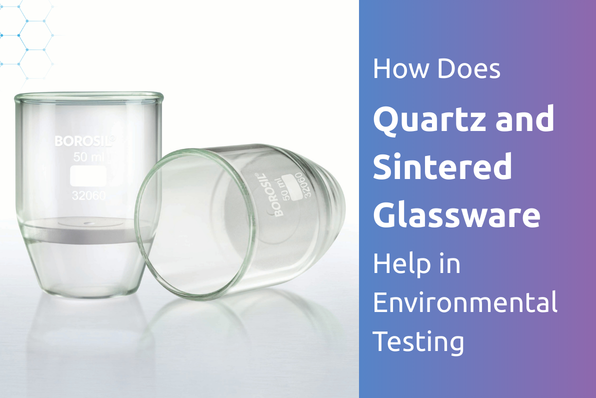
Filtration is a crucial aspect in preparing environmental samples, particularly for the separation of suspended particles, particulates, or microbiological constituents. Sintered glass items, such as Buchner funnels and glass filter crucibles, offer a reusable, high-precision alternative to paper or polymer filters. Key benefits of such glassware include:
Quartz, as a material, isn’t just cleaner; it’s a chemically stable, thermally resilient material that is suitable for high-purity applications. What sets it apart is its performance under extreme chemical and thermal conditions. Unlike borosilicate, quartz resists leaching, even when exposed to nitric, sulphuric, or hydrofluoric acid at high temperatures. This ensures sample integrity throughout digestion and preparation, which is crucial in ultra-trace analysis.
Here’s where it matters in common workflows:
| Test Type | Step Involved | Quartz Application |
| Trace metal in water (AAS/ICP-MS) | Acid digestion | Quartz beakers/digestion tubes |
| Effluent monitoring (BOD/COD) | Sample distillation | Quartz distillation units |
| Soil leachate profiling | Extraction & evaporation | Quartz crucibles/basins |
| Pesticide analysis in runoff | Solvent evaporation | Quartz evaporation dishes |
Each of these stages demands both chemical resistance and high thermal stability. In trace metal testing, for instance, using borosilicate vessels poses a risk of trace contamination during acid digestion. Quartz digestion tubes prevent this. Similarly, in BOD/COD testing, distilled water must be ultra-pure, pyrogen-free and free from metallic ions. Borosil Scientific’s all-quartz distillation units, featuring safety cut-offs and a compact design, deliver this reliability.
In evaporation steps, whether in pesticide testing or soil extract concentration, quartz basins offer minimal residue retention, faster thermal ramp-up, and easier cleaning.
Labs that work with recurring filtration (e.g., for particulate matter in air sampling, or solids in groundwater) face a choice: use disposables like filter paper or adopt sintered glass. Sintered glass offers improved consistency over time, particularly in controlled environments.
Here’s a comparative breakdown of the properties by which sintered glass beats any other disposable alternatives, which can help you to make a choice:
| Property | Filter Paper | Sintered Glass |
| Reusability | Single-use | Reusable (with proper cleaning) |
| Filtration consistency | Variable | Uniform porosity grades (G0–G5) |
| Heat resistance | Limited | High (up to 500°C) |
| Cleaning/maintenance | Discarded post-use | Backflushing / Acid wash |
| Environmental impact | Moderate-high | Low (especially in high-throughput labs) |
Borosil Scientific’s sintered products are made with fine-grade glass frits, precision-fused for durability. When used in air sampling stations or in-field test kits, they eliminate the inconsistencies and waste generated by disposable units.
Even high-grade materials, such as quartz and sintered glass, require careful maintenance to maintain performance and extend their service life.
For Quartz Glassware:
For Sintered Glassware:
Proper handling doesn’t just extend the product lifecycle; it also protects the accuracy of your results. Even a slight clog or unnoticed crack can alter filtration dynamics or introduce contaminants.
Not all quartzware is equal. At Borosil Scientific, our line of distillation and digestion tools is specifically designed for labs that operate with high-purity workflows. Each component from the fused quartz tubes in our distillation units to the ergonomic design of the boilers is engineered to address real-world lab pain points.
Key features across the line include, but aren’t limited to:
Whether you’re running weekly BOD tests on effluent, preparing soil leachates for pesticide residue checks, or managing trace metal analysis in drinking water samples, the right glassware matters.
Environmental testing is under growing scrutiny from regulators, policymakers, and the public. Accuracy is non-negotiable, and tools like quartz glassware and sintered filters aren’t nice-to-haves; they are lab-critical.
At Borosil Scientific, we understand the demands of environmental labs. That’s why our product lines are built to support every step of the workflow, from sample prep to result validation. If you’re looking to build or upgrade your capabilities, talk to our technical team. We’re happy to help you make the right call.