











The principle of UV spectrophotometer comes from the fact that molecules can absorb both ultraviolet and visible light. Electrons move between energy levels when photons in the 180–1100 nm range hit a compound. This excitation is directly related to absorbance.
Absorbance (A) is calculated using Beer-Lambert’s law:
A = εlc
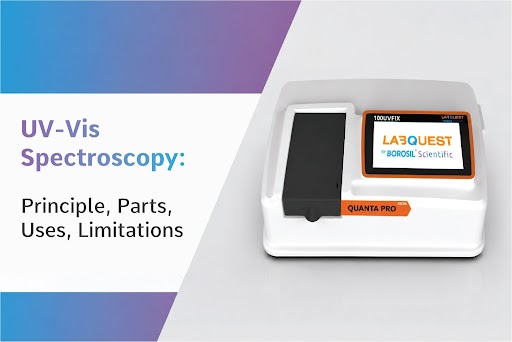
This relationship enables the simultaneous identification of analytes both qualitatively and quantitatively. Instruments like the Quanta Pro and Quanta Promax from Borosil Scientific apply this principle across full-spectrum UV-Vis analysis, providing fixed (0.1 nm) and variable (up to 4.0 nm) resolution depending on sample complexity. The wide wavelength range (180–1100 nm) enables expanded application across both organic and inorganic matrices.
A UV-Vis spectrophotometer comprises the following components:
| Component | Specification |
| Light Source | Deuterium (UV) and tungsten-halogen (Vis) lamps |
| Wavelength Control | Grating-based monochromator for fixed or variable slit width |
| Sample Interface | Cuvette compartment supporting various pathlengths (1–100 mm) |
| Detector | Silicon photodiode or CCD with high sensitivity and dynamic range |
| Data Handling Unit | Embedded PC with desktop-class OS; 10-inch capacitive touchscreen UI |
Pre-aligned optics and lamp replacement without tools make maintenance easier on Borosil Scientific models. The cuvette chamber can hold both square and rectangular cuvettes, as well as holders for more than one cell. This makes sure that the system can handle both low-volume and high-throughput workflows. Automatic wavelength calibration makes the measurements more accurate when they are done in groups.
UV-Vis spectroscopy plays a central role across regulated and research domains:
| Sector | Use Case |
| Pharmaceuticals | API quantification, dissolution profiling, stability testing |
| Environmental | Detection of nitrate, phosphate, chromium (VI), phenol in water samples |
| Biotech | Nucleic acid (DNA/RNA) and protein concentration (A260/280 nm ratio) |
| Academia | Analytical chemistry practicals, absorbance curve plotting |
| Industrial QC | Pigment/dye concentration control, raw material verification |
The Quanta Promax integrates Wi-Fi for remote access and data sharing which are especially useful in multi-user or multi-instrument facilities. By connecting tablets and laptops wirelessly, analytical workflows are sped up.
| Model | Spectral Range (nm) | Resolution | Interface | Key Features |
| Quanta Pro (100UVFIX) | 180–1100 | 0.1 nm (Fixed) | Capacitive touchscreen | Single-cell analysis; fixed slit; excellent baseline stability |
| Quanta Promax (100UVVAR) | 180–1100 | 0.1–4.0 nm (Variable) | Embedded desktop OS + Wi-Fi | Multi-mode operation; variable bandwidth; auto wavelength changeover |
Both units are suitable for UV-transparent cuvettes (quartz), with backward compatibility for visible-only workflows using glass cells. Pre-installed method templates support rapid validation in QC settings.
Despite its versatility, UV-Vis spectroscopy has constraints that must be considered:
| Issue | Impact | Mitigation Strategy |
| Turbidity | Scattering interferes with absorbance | Filter or centrifuge samples before loading |
| Solvent absorption | Background interference | Use UV-grade ethanol/methanol or appropriate blanks |
| Peak overlap | Low selectivity in complex mixtures | Use derivative or chemometric analysis where needed |
| Detector drift | Variability over long sessions | Regular calibration using standard references |
Notably, water and alcohols absorb below 200 nm; choose solvents accordingly when operating in the deep UV range.
A UV-Vis spectrophotometer will always give accurate results and last for a long time if it is kept in the proper working order. Even small changes in the calibration can have a big effect on absorbance readings, which is very important in controlled environments like pharmaceutical quality control or environmental monitoring. Because of this, it is important to set up a structured maintenance schedule.
Routine care provides reproducible results, especially in GMP/GLP-certified laboratories. The Quanta Promax system supports automated lamp diagnostics and firmware upgrades, simplifying preventive maintenance.
| Mode | Use Case |
| Fixed Wavelength | Routine assays where target absorbance is known |
| Spectral Scan | Identification of unknowns, method development |
The Quanta Pro is ideal for fixed-parameter workflows. In contrast, Quanta Promax allows adjustable bandwidth, making it suitable for labs dealing with variable analyte classes.
UV-Vis spectroscopy is a standard method used in labs that need to get quick, accurate readings of absorbance. It is necessary because it is fast, cheap, and easy to use. A solid understanding of the UV spectrophotometer principle, combined with the right equipment configuration, can significantly improve throughput and result quality.
We at Borosil Scientific manufacture purpose-built instruments like the Quanta Pro and Quanta Promax UV-Vis spectrophotometers to meet the real-world demands of today’s analytical laboratories. Our systems are designed for flexibility, compliance, and long-term reliability, whether you’re running a single compound assay or screening complex mixtures.